
 E-Paper



HT This Day: June 05, 1950 -- Division of railways into six zones
The Government’s tentative scheme for the regrouping or Railways was published today

 Prefer HTon Google


The Government’s tentative scheme for the regrouping or Railways was published today.
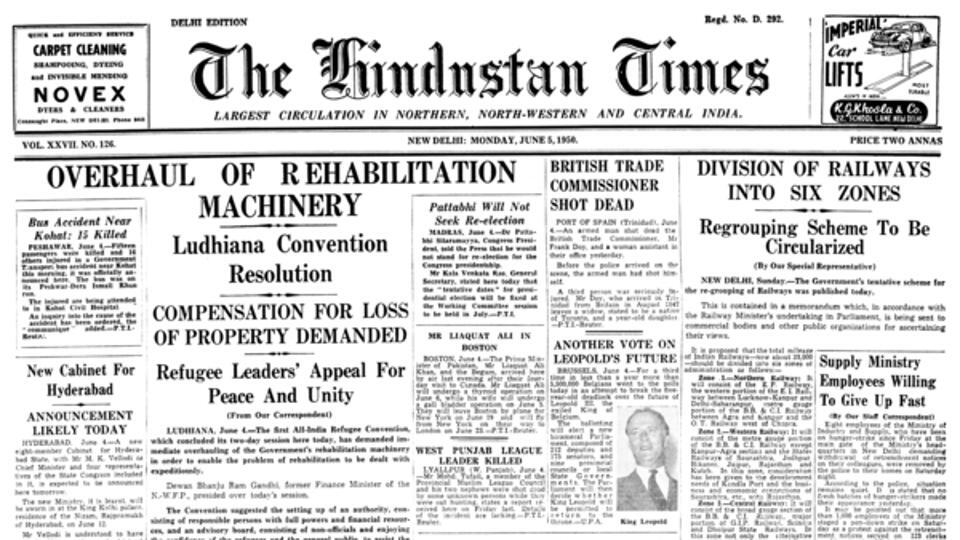
This is contained in a memorandum which, in accordance with the Railway Minister’s undertaking in Parliament, is being sent to commercial bodies and other public organizations for ascertaining their views.
It is proposed that the total mileage of Indian Railways-now about 33,000 -should be divided into six zones of administration as follows:
Zone .1.-Northern Railway: It will consist of the E. P. Railway, the western portion of the E. I. Rail. way between Lucknow-Kanpur and Delhi-Saharanpur, metre gauge portion of the B.B. & C.I. Railway between Agra and Kanpur and the O. T. Railway west of Chapra.
Zone 2.-Western Railway: It will consist of the metre gauge portion of the B.B. & C.I. Railway except Kanpur-Agra section and the States Railways of Saurashtra, Jodhpur. Bikaner. Jaipur, Rajasthan and Kutch. In this zone, consideration has been given to the development needs of Kandla Port and the business and economic connections of Saurashtra, etc., with Rajasthan.
Zone 3.-Central Railway: It will consist of the broad-gauge section of the B.B. & C.I. Railway, major portion of G.I.P. Railway, Scindia and Dholpur State Railways. In this zone not only the alternative routes from the major port of Bombay to Northern India, but also the lines of communication between Bombay and the industrial areas around it have been placed under one administration.
Zone 4-Southern Railway: It will consist of the S. I. Railway (both broad gauge and metre gauge), major portion (broad gauge) and entire portion (metre gauge) of the M. & S. M. Railway and the entire Mysore State Railway. Both geographically and from the railway operating point of view, grouping together of all the Southern Railways is the ideal arrangement.
Zone 5.-Eastern Railway: It will consist of the N.S. Railway, portions of the G. I. P. and M. & S. M Railways and the 8.N. Railway excluding the coalfield area of Bengal and Bihar and Howrah-Kharagpur section.
Zone 6.-North-Eastern Railway. I It will consist of the E.I. Railway east of Lucknow-Kanpur, the coalfield area of Bengal and Bihar at present with B. N. Railway, Howrah-Kharagpur section, O. T. Railway east of Chapra and the Assam Railway including the Assam Rail Link and the Darjeeling-Himalayan Railway.
OBSTACLES TO REGROUPING
The existing railway administrations have grown to haphazardly owing to historical reasons. The Company system had originally been formed more or less on accidental considerations. Often the main consideration was financial. There has been a persistent demand for rationalization and regrouping of the existing systems. So long as at the major railways had not come under State management this was not possible. The railways of Indian States cutting across the other railway administrations like that of the Nizam’s State Railway was another serious obstacle to rationalization, as also the existence of various small railway administrations owned and controlled by the Rulers of Indian States.
The partition of India in August, 1947. involved the breaking up of the old North-Western Railway and the Bengal-Assam Railway and India has been left with rumps of those systems in the Eastern Punjab Railway and the Assam Railway which cannot in any case continue as economic and self-sufficient units. The final integration of the Indian States Railways from April 1, 1950, as removed the major obstacle towards regrouping. The time is, therefore. fully ripe for reorganizing the Indian Railways on a rational basis.
The Railway Board have been considering this question for the past many months and have reached tentative conclusions. They realize. however, that the question is of such great importance that no final decision should be taken without giving the country and all interests concerned in railway transport ample opportunities for consideration and comment. The tentative scheme is, therefore, being released to the State Governments, the various Chambers of Commerce, the Railway labour organizations and the public with the request that their considered views may be sent to the Railway Board before August 31, 1950.
FOUR-FOLD PRINCIPLES
The main principles underlying the tentative scheme are four-fold:
(1) Every railway administration should serve as far as possible a compact region.
(2) It should be large enough to provide a headquarters organization of the highest caliber capable of following and assimilating up-to-date improvements in railway technique and equipped with adequate workshop facilities and statistical, training and research institutions.
(3) The regrouping should cause the minimum dislocation in the existing arrangements and should be so phased as to prevent any kind of dislocation or even temporary diminution of the quantity or efficiency of railway service.
(4) While the existing proposals do not indicate the nature of the internal administration of each group, viz., whether it should be on a Divisional or District System, it is not proposed to adopt any dogmatic attitude in the matter and the vital necessity of causing minimum dislocation will also govern the decision on this important issue.
The memorandum states:
The Government’s final proposals are expected to be ready when Parliament meets later in the year. It will be remembered that the Kunzru Committee recommended that the regrouping of Railways should be taken up after five years owing to the then unsettled conditions. The Government, however, feel that conditions are now very different from what they were at the time of the Kunzru Committee s report. It is felt that, with the integration of Indian State Railways on April 1. the time is now ripe for the regrouping of Indian Railways on a national basis.


