New Delhi Among the key achievements outlined in the India-US joint statement issued after Prime Minister Narendra Modi and President Joe Biden’s meeting on Friday, there is a common theme: technology.
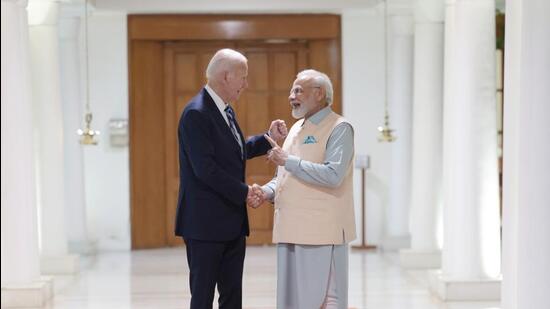
Both Biden and Modi, according to the statement, reaffirmed “technology’s defining role in deepening our strategic partnership” and lauded the efforts under the initiative on critical and emerging technologies (iCET) to “build open, accessible, secure, and resilient technology ecosystems and value chains, based on mutual confidence and trust, which reinforce our shared values and democratic institutions”.
The idea of the iCET was born in a Modi-Biden meeting in Tokyo on the sidelines of Quad in the summer of 2022. It was formally unveiled by the two national security advisers (NSAs), Jake Sullivan and Ajit Doval, in January 2023. iCET formed the backbone of the deliverables during Modi’s visit in June 2023 to the US. And, now, in September 2023, there is even more progress under the framework, which, by any account, makes it one of the most efficient mechanisms in the crowded India-US bilateral matrix. The subtext of a range of initiatives under the mechanism is the jointly felt need in both Delhi and DC to counter Beijing.
In the joint statement on Friday, this took seven specific forms.
{{/usCountry}}In the joint statement on Friday, this took seven specific forms.
{{/usCountry}}Space
The first is space, with Biden first congratulating Modi and the Indian Space Research Organisation (Isro) on Chandrayaan-3’s success and the launch of Aditya-L1. Biden and Modi welcomed efforts towards establishment of a working group for commercial space collaboration under the existing India-US Civil Space Joint Working Group; underlined that Isro and Nasa have “have commenced discussions on modalities, capacity building, and training for mounting a joint effort to the International Space Station in 2024”; and said that two sides were continuing to finalise a strategic framework for human space flight cooperation by the end of 2023.
They also announced their intent to deepen cooperation on planetary defence.
Semiconductors
Two, on semiconductors, after the investment announcements made by Micron, Lam Research and Applied Materials during Modi’s June visit, Biden and Modi reiterated their commitment to build resilient semiconductor supply chains. They noted a multi-year initiative of Microchip Technology to invest approximately $300 million “in expanding its research and development presence in India” and Advanced Micro Device’s announcement to invest $400 million over the next five years “to expand research, development, and engineering operations in India”.
Telecommunications
Three, on the basis of a “shared vision of secure and trusted telecommunications, resilient supply chains, and global digital inclusion”, both leaders welcomed the signing of a memorandum of agreement between Bharat 6G Alliance and Next G Alliance, operated by Alliance for Telecommunications Industry Solutions, “as a first step towards deepening public-private cooperation between vendors and operators”. They also noted the formation of two task forces focused on collaboration in the domain of Open RAN and research in 5G and 6G technologies. “A 5G Open RAN pilot in a leading Indian telecom operator will be undertaken by a U.S. Open RAN manufacturer before field deployment,” the joint statement added.
Quantum
Four, in quantum, the US reiterated its commitment to work with India both bilaterally and through the Quantum Entanglement Exchange, a platform to facilitate international quantum exchange opportunities. The leaders welcomed the participation of SN Bose National Center for Basic Sciences as a member of the Quantum Economic Development Consortium, and noted that IIT-Bombay had earlier joined the Chicago Quantum Exchange.
Education
Five, in the field of education, in another sign that the India-US knowledge partnership is deepening, the two leaders welcomed the signing of a memorandum of understanding between Indian universities, represented by the Council of Indian Institutes of Technology (IIT Council), and the Association of American Universities (AAU) “to establish the India-US Global Challenges Institute, with a combined initial commitment of at least US$10 million”. This institute will bring together leading research and higher education institutions from both countries to “advance new frontiers in science and technology, spanning collaboration in sustainable energy and agriculture, health and pandemic preparedness, semiconductor technology and manufacturing, advanced materials, telecommunications, artificial intelligence, and quantum science”, all of which are identified as areas of deeper ties under iCET.
Biotechnology
Six, Biden and Modi hailed the “signing of an Implementation Arrangement between the US National Science Foundation (NSF) and India’s department of biotechnology to enable scientific and technological research collaborations in biotechnology and biomanufacturing innovations”.
Defence
Seven, on defence, the GE jet engine deal is a part of the defence industrial cooperation road map under iCET. In addition, the two leaders commended the work of the India-US Defence Acceleration Ecosystem (INDUS-X) in “establishing a robust collaboration agenda to harness the innovative work of the US and Indian defence sectors to address shared security challenges”. INDUS-X has already convened the inaugural Academia Start-up Partnership at IIT Kanpur, with the participation of Penn State University, and initiated the Joint Accelerator Program for Indian Startups, through a workshop led by US accelerator Hacking 4 Allies (H4x) and IIT Hyderabad in August 2023. They also welcomed the announcement of both defence ministries to launch two joint challenges.
And finally, in a sign that both countries recognise that operationalising all of this will require continuous work on the internal front in terms of regulations, Biden and Modi recommitted their administrations to promote policies and adapt regulations that “facilitate greater technology sharing, co-development, and co-production opportunities between Indian and US industry, government and academic institutions” and welcomed continued engagement through an “inter-agency monitoring mechanism under the auspices of the bilateral Strategic Trade Dialogue”, which was launched in June 2023.