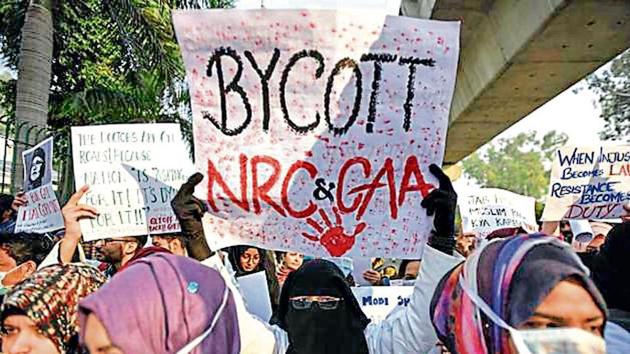
As students of Jamia Millia Islamia continued to demonstrate against the Citizenship Amendment Act (CAA) on Tuesday, the absence of an official students’ union stood out. Jamia’s last students’ union was disbanded in 2006 and the matter is currently sub-judice.
“Having an elected body means that the collective voice can be known through union,” said Professor Rizwan Qaiser, who was the secretary of Jamia Teachers’ Association when the last students’ union was disbanded. A senior official of the varsity said the administration had no role in the matter.
Among the several committees formed against the Citizenship Amendment Bill (CAB) was the Jamia against CAB Forum. It was formed in November. It had given the call for a march to Parliament House on December 13. The march was stopped by police and the ensuing clash had left many injured. Two days later, police entered the campus and assaulted students, sparking more student protests across the country.
“Many among those who were leading the movement till December 15 were injured or scared or had lost their phones. Everything was scattered, campus was closed, and spontaneous protests continued. So, we set up Jamia coordination committee (JCC) which has representatives from around 15 students’ outfits on campus,” said Safoora Zargar, an independent member of the committee and an Mphil student.
The JCC has been involved in organising peaceful protests since. Several committee members said a major challenge was to control the crowd which gathered at the road outside the campus and tried to march towards New Friends Colony — where protesters had torched buses and vehicles following a violent clash with police on December 15. “To ensure no further violence takes place, we started forming human chains and restricting protesters from marching ahead,” Zargar added.
{{/usCountry}}The JCC has been involved in organising peaceful protests since. Several committee members said a major challenge was to control the crowd which gathered at the road outside the campus and tried to march towards New Friends Colony — where protesters had torched buses and vehicles following a violent clash with police on December 15. “To ensure no further violence takes place, we started forming human chains and restricting protesters from marching ahead,” Zargar added.
{{/usCountry}}In order to take decisions on modes of protest and innovative ideas of demonstration, JCC conducts general body meetings with over 45 students ‘representatives from different outfits, including All India Students Association (AISA), Students’ Federation of India (SFI), Dayare Shauq Students’ Charter (DISC), Chatra Yuva Sangharsh Samiti (CYSS), and Students Islamic Organisation of India (SIO). The students also arrange for talks by academicians and carry out awareness campaigns on CAA in the locality. The challenge, however, remains to get consensus on decisions.
“An elected students’ body would have helped since they also have allegiance and that helps in decision-making as well as mobilisation. JCC does not have any authority since we are not elected,” said a JCC member, requesting anonymity.
“Right now, we have a source for funds. But if there was a union, getting funds would have been easier,” said Arjun Ramachandran, a postgraduate student at the varsity and another member of the committee. Ramachandran added that lack of elected body has also helped in some way. “Right now, those interested in the movement are participating. But when it is a union, some outfits, which are not elected, may be left out.”