BHUBANESWAR: The Central government has told the Odisha government that its ordinance to bring the 11th-century Lingaraj temple in Bhubaneswar and its associated temples under a special law is outside the “legislative competence” of the state legislature and could lead to conflict with the Ancient Monuments and Archaeological Sites and Remains Act, 1958 (AMASR Act)
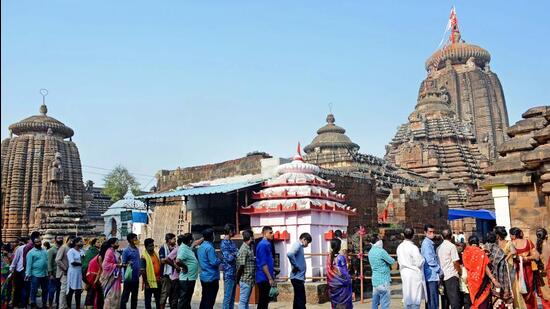
In December 2020, Naveen Patnaik led cabinet approved an ordinance to bring Lingaraj Temple, the largest temple in Bhubaneswar and 8 other associated temples, under the control of Lingaraj Temple Managing Committee, similar to the one for Jagannath Temple in Puri.
The Lingaraj temple was earlier covered under the Odisha Hindu Religious Endowment Act.
The Jagannath temple was the first temple in Odisha to have a special law enacted in 1955 after being under British control for a long time. The ordinance provided an administrator, quite like the Jagannath temple and servitor system with hereditary rights.
In December 2019, the Patnaik government unveiled the Ekamra Kshetra Development project for the development of the area around Lingaraj temple to revive the heritage and cultural value of the ‘temple city’”.
However, the ordinance sent to the Centre for vetting has run into hurdles. The Ministry of Home Affairs has said several sections of the proposed ordinance were in conflict with the AMASR Act. The ministry has pointed that the state government has already violated the AMASR Act around Lingaraj temple by building modern structures.
{{/usCountry}}However, the ordinance sent to the Centre for vetting has run into hurdles. The Ministry of Home Affairs has said several sections of the proposed ordinance were in conflict with the AMASR Act. The ministry has pointed that the state government has already violated the AMASR Act around Lingaraj temple by building modern structures.
{{/usCountry}}Citing objections from the culture ministry, the judicial and political prisoners section of the home ministry said that since the ordinance covers 12 centrally protected monuments including the Lingaraj temple and 3 tanks it was outside the legislative competence of the state legislature as it violates the provisions of AMASR Act, 1958.
“These centrally protected monuments are governed by the Ancient Monuments and Archaeological Sites and Remains Act, 1958. As per the said Act new constructions are not allowed in prohibited area (100 metre zone from protected monument). Further, 200 metre area beyond prohibited area has been declared as regulated area where permission from competent Authority on recommendation from the National Monuments Authority is required to undertake construction-related activities including repairs. ASI is responsible for the conservation and preservation of these 12 centrally protected monuments. Certain clauses of the ordinance also relate to conservation and repair of the Temples/Tanks. Such conflict is not in the interest of maintaining these centrally protected monuments in their original form for posterity. As such the dual administrative authorities will results into continuous conflict,” the letter sent to the Odisha Governor’s office last week said.
The ministry said while clause 15(2) of the Odisha ordinance has a provision for retail shops for sale of commodities inside or outside of the temples, AMASR Act provides that a monument should not be used for any other purposes not consistent with its character.
The ministry also pointed out that clause 17(3) of the Odisha ordinance refers to lease or sale of movable’ or immovable property. Movable property may include archaeological or artistic object (meaning antiques) and in that case, it will be in conflict with the AMASR Act, 1958 or AAT Act, 1972, the Centre said.
The ministry said that clause 22(2d) of the ordinance provides for certain powers to the temple committee to undertake repairs, for which the Archaeological Survey of India is responsible. Therefore, this clause is also in contradiction with the provision of the AMASR Act, 1958, it said.
The ministry said the ordinance’s clause which provides for special darshan on payment of fee was in violation of the existing agreement between ASI and temple management; which clearly stipulates “public would have free access to monument”.
The Ordinance also provides for repair and construction of new buildings in violation of the central law. Constructions can only be allowed by the National Monuments Authority.
The ordinance also gives the temple committee the right to undertake repairs, though this responsibility falls on the ASI under the central law.
“If such repairs are taken up by non-expert agencies, it will be difficult to maintain the centrally protected monuments in their original form. Modern structures within the temple complex impacting the aesthetics of the temple have already been constructed by the temple administration/state government in violation of the AMASR Act,” the ministry said.
The ministry also objected to considerable construction having been done by the state government in the prohibited area of the Lingaraj temple and other centrally-protected monuments existing in proximity to the temple.
“If this Ordinance is promulgated, such blatant violations shall continue and it will be difficult to maintain the centrally protected monument accordingly to existing statute,” the ministry said.
The ministry further said as there is a restriction on construction-related activity within the premises of centrally protected monuments, the conflict will always remain while taking up conservation and preservation work of the 12 centrally protected monuments.
Assistant Legal Remembrancer-cum- additional secretary in the law department, Lalatendu Jena, refused to comment on the questions raised by the Centre.