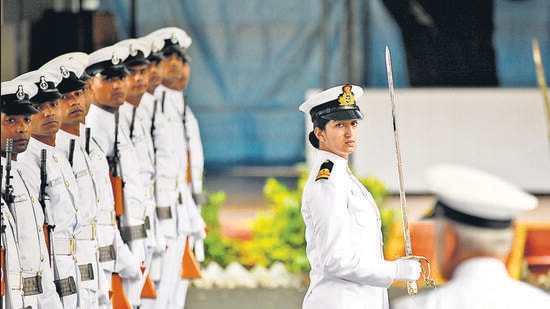
The Indian Navy has decided to open the doors of its elite special forces to women, a development that will allow them to serve as commandos for the first time in any of the three defence services, senior officials familiar with the matter said on Sunday.
The special forces of the army, navy and air force consist of some of the toughest soldiers who undergo rigorous training, are capable of mounting a swift and stealthy response in denied territories, and
The Indian Navy has decided to open the doors of its elite special forces to women, a development that will allow them to serve as commandos for the first time in any of the three defence services, senior officials familiar with the matter said on Sunday.
The special forces of the army, navy and air force consist of some of the toughest soldiers who undergo rigorous training, are capable of mounting a swift and stealthy response in denied territories, and have thus far been a male preserve.
Also read | Navy Chief on inducting women officers: '…looking at being gender-neutral force'
“Women in the navy can now become marine commandos (Marcos) if they choose to and meet the criteria. It’s truly a watershed in India’s military history. But no one is directly assigned to special forces units. People have to volunteer for it,” said one of the officials cited above, asking not to be named. The option of volunteering to become Marcos will be open to both women officers and sailors who will join the service as Agniveers next year, said a second official.
The Marcos are trained for a raft of missions and can operate in sea, air and land.
These commandos can conduct clandestine attacks against enemy warships, offshore installations and other vital assets, specialised diving operations, and surveillance and reconnaissance missions to support naval operations. They can also fight terrorists in a maritime environment, and have been deployed in Kashmir’s Wular lake area in a counterterror role.
“From special operations to flying to warship duties, no wing of the navy now bars women. It has transformed itself into a fully gender-neutral force. If you have what it takes, there’s no dearth of opportunities,” said a third official.
The opening of the navy’s special forces wing to women comes at a time when the force is on the threshold of inducting them in the personnel below officer rank (PBOR) cadre for the first time. The navy is closely monitoring the training of its first batch of Agniveers, including women, at the INS Chilka training establishment in Odisha. The navy’s first batch of Agniveers consists of 3,000 trainees including 341 women.
INS Chilka, the sprawling lakeside campus, earlier got a raft of facilities to make life is easier for the women who are on the threshold of a naval career. From earmarking two new accommodation blocks exclusively for them to installing sanitary pad vending and disposal machines, and a separate dining area to hiring women staff, the navy took several measures to make the training establishment women-friendly.
Other changes made at INS Chilka include setting up of more toilets for women trainees, installation of security cameras and hiring women as matrons, swimming instructors and safai karamcharis.
Three decades after the military commissioned its first batch of women officers in the short-service stream, the armed forces have come a long way and are now offering them a raft of opportunities that have given them new hard-earned identities, empowered them and helped bridge the gender gap significantly in a traditionally male-dominated field, as previously reported.
Women in uniform are no longer on the fringes but are being assigned central roles on a par with their male counterparts – they are flying fighter planes, serving on board warships, being inducted in the personnel below officer (PBOR) cadre, eligible for permanent commission, and, the first batch of women candidates is currently undergoing training at the National Defence Academy.
While the government and the armed forces have taken steps to promote gender-neutrality in the military system, the courts have also played an important role in pushing inclusion. The courts have passed landmark judgments over the years to overturn rules that restricted women from being granted permanent commission, and therefore pension, like their male counterparts, and also made them eligible for NDA.
One Subscription.
Get 360° coverage—from daily headlines
to 100 year archives.
Archives
HT App & Website