Even as the debate over a hike in the age of marriage for girls from 18 years to 21 years rages in the country following the introduction of the Prohibition of Child Marriage(Amendment) Bill 2021, over 10,000 villages in Odisha in more than two years have declared themselves to be free from the bane of child marriage.
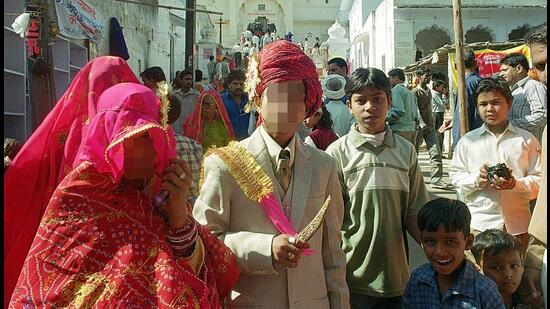
Officials in the state women and child development department said after unveiling of the Strategic Action Plan in 2019 to completely stop the marriage of girls below 18 years and boys below 21 years, the department has managed to make over 10,000 villages child-marriage free.
“Through the action plan, we developed a robust management information system for proper monitoring of such marriages at village level and involved Anganwadi workers, Panchayati Raj institution functionaries as well as village elders. Though we have a long way to go we hope to succeed,” said Bhaskar Jyoti Sarma, secretary in the women and child development department.
In the National Family Health Survey-4 conducted in 2015-16, the rate of child marriage among girls in Odisha was 21.3, lower than the national average of 26.8. In the National Family Health Survey-5 conducted in 2019-21, the results of which were revealed in November last year, the child marriage rates among girls had dropped to 20.5, indicating that Odisha was doing well in preventing marriages among girls below the age of 18 years.
However, the same survey revealed that half of the 30 districts of Odisha had a child marriage prevalence rate of more than 20%. At 39.4%, Nabarangpur reported the highest child marriage incidents followed by Nayagarh (35.7%), Koraput (35.5%), Malkangiri (32.4%), Rayagada (33.2%) and Mayurbhanj (31.2%). Other 7 districts reporting more than 20% are Balasore, Boudh, Dhenkanal, Gajapati, Dhenkanal, Angul and Ganjam.
{{/usCountry}}However, the same survey revealed that half of the 30 districts of Odisha had a child marriage prevalence rate of more than 20%. At 39.4%, Nabarangpur reported the highest child marriage incidents followed by Nayagarh (35.7%), Koraput (35.5%), Malkangiri (32.4%), Rayagada (33.2%) and Mayurbhanj (31.2%). Other 7 districts reporting more than 20% are Balasore, Boudh, Dhenkanal, Gajapati, Dhenkanal, Angul and Ganjam.
{{/usCountry}}NGO workers on the ground said poverty is one of the main reasons for families to opt for child marriage. “Girls from poor households are more likely to marry as it would lead to reduction in the size of the family while boys under the age of 21 years are married as it would lead to adding one more working hand in the family,” said Ghasiram Panda, national manager for NGO Action Aid India’s Ending Child Marriage Programme.
Officials said the 10,000 villages claiming that they were child-marriage free over the last 2 years was a result of several innovative practices adopted by the respective district administration.
In Ganjam district which is among the 15 districts where child marriage is quite prevalent, the district collector started a programme called Nirbhaya Kadhi which translates to Fearless Bud.
“The campaign was initiated in 2019 from the village level in which all stakeholders including the adolescent girls, Anganwadi workers, ASHA workers and PRI members were made member of a committee that keeps an eye on such marriages. We asked heads of all schools to inform the administration if any girl aged between 12 and 18 remains absent from school for five days and then follow up with the families of the girls through teachers and other grassroots workers,” said Ganjam district collector Vijaya Amrita Kulange. The district administration also raised the reward for any tip-off about child marriages from ₹5,000 to ₹50,000.
The administration also made the production of Aadhaar card mandatory for any marriages to take place. “As part of the campaign, every 3rd Saturday of the month was called Nirbhaya Kadhi day for effective engagement and awareness against child marriages,” he said. The Ganjam district administration was able to stop 450 child marriages and video-record 48,383 marriages in 2020 and 2021.
In Boudh, another district which sees a high percentage of girls under the age of 18 years getting married, the district officials have formed village-level child marriage prevention committees that meet once a month to see which families would have marriage functions. “Marriage registers are maintained in each village and in the event of any family found to be marrying off their daughter under the age of 18 years and son under the age of 21 years then they are counselled and prevailed upon. If counselling is not successful, then the girl is rescued and rehabilitated till she turns 18 years,” said Rahul Pradhan, district child protection officer of Boudh.
The efforts taken have led to over half of the 700-odd villages in the district being child marriage free.
In the western Odisha district of Sonepur, the district authorities are running a Sankalp campaign in every village through formation of child marriage prevention committees in villages. Every Thursday, meetings are organised in villages to raise awareness against child marriage. The villages too maintain marriage registers to keep a check on any family trying to get underage boys and girls married off. “So far 767 of the 960 villages have been made child marriage free due to the efforts of the administration and villagers,” said Rakesh Pradhan, district coordinator of Action Aid.
In Deogarh district, the village committee has made it mandatory for families to provide a copy of Aadhar of the bride and groom before any marriage can happen.
Though there are no particular parameters for any village to be declared as child marriage free, the standard guideline is it should have a functioning task force, a database of all adolescents, no instance of child marriages for the last two years, a duly maintained register of the task force and submission of the villagers to declare the village ‘child marriage free’.
“All these things are then sent to the district collector and finally the women and child development department in Bhubaneswar. Once the chief child marriage prohibition officer in Bhubaneswar approves of it then the village is declared child marriage free,” said Ghasiram Panda of Action Aid.
Officials said the NFHS-5 may not have managed to reflect the actual drop in child marriages. “We have managed to prevent around 2000 marriages in the last 2 years and managed to impress a large number of people about the criminal part of the action through sustained campaign. The next round of NFHS would surely show that Odisha’s child marriage rates have dropped drastically,” said a senior officer of the department.