Prime Minister Narendra Modi on Saturday tweaked the government’s approach to the 21-day lockdown ordered last month to stop the spread of the highly contagious coronavirus disease. The prime minister, who interacted with chief ministers, stressed that the new challenge was not only to save lives, but livelihoods also.
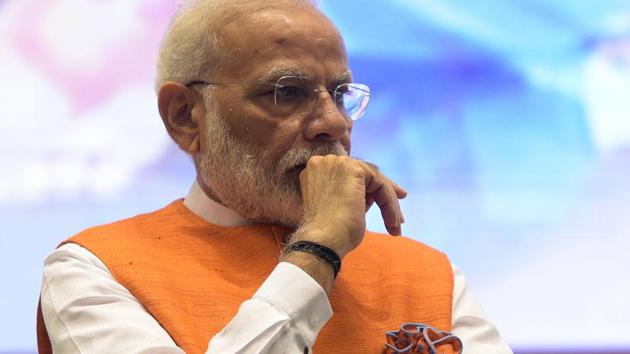
PM Modi underlined that the motto of the government earlier was ‘jaan hai to jahaan hai’ [when you have life, you have the world].
“Now it is ‘jaan bhi jahaan bhi’ [save life, and livelihood],” he said, signalling a shift in the Centre’s approach. PM Modi didn’t elaborate. An official in the Prime Minister’s Office later said he would finalise the country’s strategy closer to April 14 after some more deliberations.
Incidentally, chief ministers of several opposition-ruled states such as Punjab and Maharashtra have gone ahead to extend the lockdown. In contrast, NDA chief ministers have left the decision to PM Modi who is expected to take a more nuanced approach.
“The extension of lockdown this time will be conditional so that the economy also gets kickstarted in crucial areas,” said another PMO official.
Also watch | PM Modi interacts with chief ministers of states: Key takeaways
{{/usCountry}}Also watch | PM Modi interacts with chief ministers of states: Key takeaways
{{/usCountry}}India was one of the few countries in the world to have imposed a national lockdown long before the disease started spreading in the country. A study by the University of Oxford’s Blavatnik School of Government says India was quicker than almost every other country in imposing a lockdown on March 25.
Also read | Considering request, says Centre on CMs’ pitch to extend Covid-19 lockdown
This approach, the Health Ministry said after the prime minister’s video conference, had helped control the spread of the disease. The government pointed to estimates that had projected 8.2 lakh Covid-19 cases in the country by April 15 if the government had not implemented the containment or nationwide lockdown. The cases were projected to drop to 1.2 lakh cases if India only took containment measures but did not enforce the lockdown.
Since the government has acted, India only has 7,447 cases on April 11, the health ministry said.
Having seen the efficacy of the lockdown to stop the spread of the disease that has killed more than 100,000 people across the world, most chief ministers advocated extending the lockdown by another two weeks.
At Saturday’s meeting, PM Modi, according to an official statement, “emphasised the criticality of coming 3-4 weeks” to determine the impact of the steps taken till now to contain the virus.
But Prime Minister Narendra Modi is deeply conscious of the impact that the lockdown is having on the poor, and the economy in the long run, a senior government official familiar with the developments told Hindustan Times.
At this stage, there is a view in the government that a blanket extension of the lockdown by another two weeks would be the easier thing to do. The more difficult would be getting the country, economy and the lives of people back on track without compromising lives.
This is the blueprint that Prime Minister Narendra Modi has been working on.
The broad principle that has been underlined at many of the meetings being held to firm up the lockdown strategy is to recognise that there are many parts of the country that do not have a single case of coronavirus, or even a suspected case. The lockdown could be eased in such areas. “You need to recognise the fact that nearly half of all the Covid-19 cases in the country are reported from just three states: Maharashtra, Delhi and Tamil Nadu,” a government official said.
Besides, when PM Modi takes the call on the national lockdown, the official said, he will account for the fact that the harvesting season begins from April 14.