Officials fell back on the Very High Frequency (VHF) communication system of the Odisha police department when satellite phones became dysfunctional as Cyclone Fani made landfall on May 3 in Puri coastal district.
The Odisha government has built about 880 cyclone shelters across the coast since a super cyclone hit the state in 1999. It also procured satellite phones for its key officials at district and block headquarters to stay in touch once the traditional mode of communications like landline or mobile phones go dead.
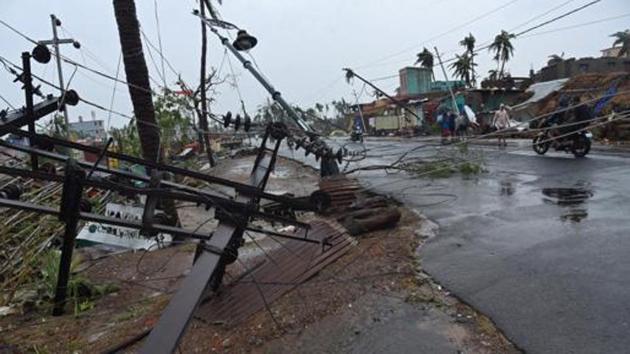
The VHF system kept the lines of communication open in the aftermath of the Cyclone Fani as it damaged mobile towers and threw the communication system out of gear.
“As the mobile phone communication [system] snapped within the first hours of the cyclone… the district collector tried speaking to officials at state headquarter in Bhubaneswar and another official at Satpada near Chilika on his satellite phone. But it was difficult hearing the other side. So we gave up and returned to the VHF mode of communication,” said inspector general of police (central range) Soumendra Priyadarshi.
The VHF system was set up in the offices of the district collector, public health division, local municipality, fire station, block development offices, armed reserve police office and district Intelligence Bureau unit of Puri district. With no other communication system available, the State Emergency Operation Centre in Bhubaneswar soon got in touch with the Puri district administration through the VHF system.
{{/usCountry}}The VHF system was set up in the offices of the district collector, public health division, local municipality, fire station, block development offices, armed reserve police office and district Intelligence Bureau unit of Puri district. With no other communication system available, the State Emergency Operation Centre in Bhubaneswar soon got in touch with the Puri district administration through the VHF system.
{{/usCountry}}A revenue department official said satellite telephones work when their antennae are aligned with the satellites orbiting the Earth. “So a user needs to get out of a building and be in the open. The voice quality is also not that good.”
Cyclone Fani knocked down almost all the VHF antennae at all police stations in Puri except the one in Town police station that miraculously survived the 250 kmph winds. At Konark and Satyabadi police stations, officials had disassembled the VHF towers before the cyclone. They quickly reassembled them after the storm passed and the system started working in a few hours, said officials.
In the control room at Puri, VHF operator Biswanath Mishra had doubts about the VHF antenna holding up against the winds as the sturdy CCTV control towers were blown away. “When a CCTV control tower banged against my window, I thought the VHF antenna would also be gone. But the voices kept cackling through the system even as the winds raged,” said Mishra.
The VHF system is working well with everyone starting from chief secretary to the police chief and others officials using it for regular communication. “The batteries of VHF need to be charged and we had kept adequate diesel for a generator. A repeater station at Delang boosted the signal and the messages got transmitted to state headquarters without any problem,” said Mishra.
Special Relief Commissioner Bishnupada Sethi said the satellite phone system has its advantages and disadvantages. “May be we need to think of more foolproof communication systems that would work during natural disasters.”