Benaulim, Goa: India on Friday asserted that the situation in the border areas with China is “abnormal”, with external affairs minister S Jaishankar saying bilateral ties cannot be normalised if peace and tranquillity along the Line of Actual Control (LAC) continues to be disturbed.
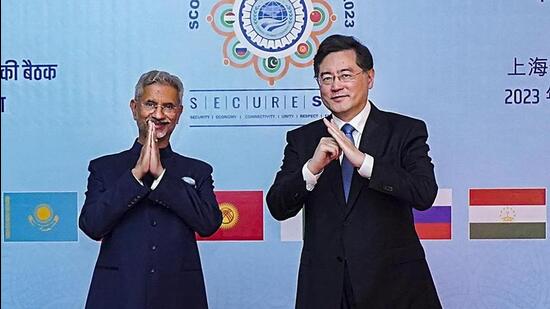
Jaishankar forcefully pushed back against repeated descriptions by the top Chinese leadership of the situation on LAC as “stable”, and said he had a “very frank” discussion on the situation along the border with his Chinese counterpart Qin Gang during their bilateral meeting on the margins of a Shanghai Cooperation Organisation (SCO) meet on Thursday.
“I think the issue is that there is an abnormal position in the border areas along the boundary and we had a very frank discussion about it. It’s not the first discussion, I had spoken to foreign minister Qin Gang on the sidelines of the G20 as well,” he told a news conference.
India and China have to take forward the process for disengagement of frontline troops in Ladakh sector of LAC, he said. He added that this is something he had conveyed to the Chinese side in a clear and frank manner in both public and private conversations.
“What I say within the room is not different from what I say outside – which is that India-China relations are not normal and cannot be normal if the peace and tranquillity in the border areas is disturbed. I’ve been very, very clear [and] very consistent about it and I have not changed my position at this meeting either,” he said.
{{/usCountry}}“What I say within the room is not different from what I say outside – which is that India-China relations are not normal and cannot be normal if the peace and tranquillity in the border areas is disturbed. I’ve been very, very clear [and] very consistent about it and I have not changed my position at this meeting either,” he said.
{{/usCountry}}Jaishankar also referred to a meeting held by Qin with members of an India-China friendship organisation in Goa on Thursday that had discussed the contributions of the noted Indian doctor Dwarkanath Kotnis and people-to-people contacts, and reiterated that bilateral relations are not normal.
“So, to suggest somehow that they are and everything else can continue and...while the relevant issues, the central problems are not being effectively addressed, I think it won’t wash,” he said.
While there may be an endeavour by the Chinese side to project a picture that the situation on the LAC is stable, India will not “play along with it”, he added.
According to a readout issued by the Chinese side following Thursday’s bilateral meeting, Qin had described the situation on LAC as “generally stable”. Qin also told Jaishankar that the two sides should continue to implement the consensus reached by Indian and Chinese leaders, “consolidate existing achievements, strictly abide by relevant agreements, push for further cooling and easing of the border situation and maintain sustainable peace and tranquillity”.
The dragging standoff on LAC, which has entered its fourth year, and a brutal clash at Galwan Valley in June 2020 that killed 20 Indian soldiers and an unspecified number of Chinese troops have taken bilateral ties to their lowest in six decades.
Jaishankar also responded to a question on whether SCO is perceived as an “anti-West” grouping by saying: “How people perceive it is something I cannot answer for. What I can say is it is a grouping where membership serves India’s interests. India has a multidirectional foreign policy with many partners, and it’s not always necessary or sometimes possible that all partners necessarily get along with other partners.”
This, he said, is a characteristic of India’s foreign policy in today’s fluid, multipolar, uncertain and volatile world. “We are members of SCO because it serves our interests. It is a major Eurasian grouping,” he said.
Jaishankar said in response to another question that there wasn’t a focused discussion on developments in Ukraine at SCO meet. There were some references to the crisis in formal and informal discussions, he said.