India’s Covid-19 test positivity rate – a key indicator of the on-the-ground spread of the disease – has soared to the highest ever and has now doubled in less than two weeks, even as the country yet again set new single-day records with more than 275,000 new cases and 1,622 new deaths on Sunday, amid reports of shortages of crucial drugs and oxygen as the second wave continued its relentless expansion.
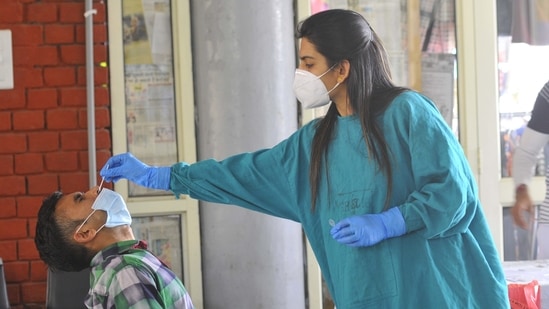
A total of 275,482 new infections were lodged on Sunday, taking the total number of confirmed cases past the 15 million mark, even as daily deaths touched a record 1,622, according to HT’s Covid-19 dashboard.
India’s testing positivity rate (TPR) – the proportion of samples returning positive for Covid-19 – touched 16.7% on Saturday, as the weekly average touched 14.3%, both the highest ever and are the latest in a series of grim milestones that the second wave of the outbreak is leaving in its wake. The previous record for highest daily positivity rate was lodged on July 19, 2020, when it touched 15.7%, and the old record for weekly positivity rate was 12.5% for the week ending July 15.
A positivity rate of 16.7% means that one out of every six samples being tested returned positive, a very high proportion for a country the size of India. And this number is even higher when looked at certain states and UTs. In Chhattisgarh, Delhi and Goa, for instance, one out of every three tests was positive, and in Maharashtra and Tamil Nadu, one in every four was positive.
{{/usCountry}}A positivity rate of 16.7% means that one out of every six samples being tested returned positive, a very high proportion for a country the size of India. And this number is even higher when looked at certain states and UTs. In Chhattisgarh, Delhi and Goa, for instance, one out of every three tests was positive, and in Maharashtra and Tamil Nadu, one in every four was positive.
{{/usCountry}}“Chhattisgarh reported the highest weekly positivity rate among states at 30.4%... India’s daily new cases continue to rise… Sixteen states are displaying an upward trajectory in daily new cases,” said Union health ministry in a statement.
Experts say that it is crucial that the chain of transmission be broken. “The most important thing at the moment is that transmission chain has to be broken... Also, extra measures need to be taken to curb super-spreader events,” said Dr K Srinath Reddy, senior public health expert, founder, Public Health Foundation of India.
The rising cases have also led to increased demand for beds, medical oxygen, and the antiviral drug Remdesivir, with people finding it hard to get any of these.
On Friday, Union health ministry sent out an advisory asking all central ministries to issue instructions to hospitals and public sector undertakings (PSUs) under their control to set up exclusive dedicated hospital wards or separate blocks within the hospitals for Covid care.
“The directive is aimed at ensuring more beds are created for Covid-19 patients as there is being seen a surge. Many of these hospitals have the capacity to act as Covid care centres and can be made use of,” said a senior government official aware of the matter, who did not want to be identified.
To meet the sudden surge in demand for medical oxygen, 162 pressure swing adsorption (PSA) oxygen plants have been sanctioned by the Centre for installation in public health facilities in all states. This step will provide additional supply of 154.19 metric tons of medical oxygen supply, the government said.
Out of 162 PSA plants sanctioned, 33 have been installed— five in MP, four in Himachal Pradesh, three each in Chandigarh, Gujarat and Uttarakhand, two each in Bihar, Karnataka and Telangana; and one each in Andhra Pradesh, Chhattisgarh, Delhi, Haryana, Kerala, Maharashtra, Puducherry, Punjab and Uttar Pradesh. By end of April, 2021, 59 more oxygen plants will be installed, and by end of May, around 80 more will get added, government has said. In addition to 162 plants already sanctioned, at least 100 additional plants are also being sanctioned on the request of several states.
As part of its initiative to ramp up Remdesivir production, the ministry of chemicals and fertilisers on Sunday announced that soon 300,000 vials per day will be manufactured in the country to meet the demand.