India may take fresh action on China on economy front
The apex China Study Group met on Monday to discuss the PLA action on the ground in Ladakh and its military posture in occupied Aksai Chin region of Tibet.
With the People’s Liberation Army (PLA) still holding forward positions on Pangong Tso and Gogra-Hot Springs area of Ladakh and showing no signs of a promised de-escalation, the Narendra Modi government is contemplating further action against China on economic front to drive home the message that India means business.
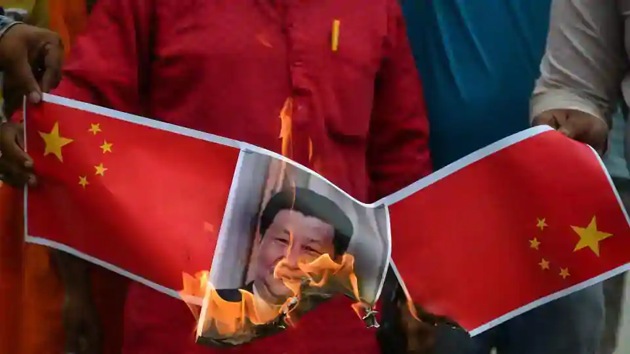
While China wants India to normalize diplomatic relations on an as-is-where-is basis, the Modi government firmly believes that anything short of status quo ante in Ladakh sector is unacceptable with a cost attached to it. (AFP photo)
{{^htLoading}} {{/htLoading}}
According to senior government officials familiar with the matter, the apex China Study Group (CSG) met on Monday to discuss the PLA action on the ground in Ladakh and its military posture in occupied Aksai Chin region of Tibet. The CSG, which has India’s senior most ministers, military leaders and bureaucrat as members, is the body that recommends the country’s course on action with China.
{{^usCountry}}{{/usCountry}}
While China wants India to normalize diplomatic relations on an as-is-where-is basis, the Modi government firmly believes that anything short of status quo ante in Ladakh sector is unacceptable with a cost attached to it. Despite being the aggressor, the PLA believes that its troops are well within it own perception of the Line of Actual Control (LAC) in Ladakh. Thus, it is holding on to the positions at both Gogra-Hot Springs as well as the green top of finger four feature of Pangong Tso lake while making unacceptable demands on Indian Army posts.
{{^htLoading}} {{/htLoading}}
{{^usCountry}}
According to officials, the Indian Army has been asked to remain in forward positions along the 1597 km LAC in Ladakh.
{{/usCountry}}
{{#usCountry}}
According to officials, the Indian Army has been asked to remain in forward positions along the 1597 km LAC in Ladakh.
{{/usCountry}}
On July 5, the Indian Special Representative on boundary dialogue spoke to his Chinese counterpart for more than two hours .
The two decided that both sides fully disengage and then de-escalate but a month later, the situation has reached a stalemate with the Chinese offering a diplomatic face-saver to India without any corresponding withdrawal on the ground.
Now that the US has taken action against Huawei and its supporting entities for spying, it is quite evident that India will also keep the Chinese communication and power companies out of any future projects.
The Modi government is clear that the bilateral ties are directly linked with the border peace and will not allow them on a parallel track as in the past.
Shishir Gupta is Executive Editor at Hindustan Times and one of India's top journalists covering national security, strategic affairs, foreign policy and geopolitics. Over the past three decades, he has extensively reported on India's military, diplomatic and security landscape, covering every major conflict and national security challenge, from the 1999 Kargil War and the 2020 East Ladakh standoff to Operation Sindoor in 2025. He has also covered major terror attacks, including the IC-814 hijacking, the 26/11 Mumbai attacks and the 2025 Pahalgam terror strike, along with numerous Pakistan-backed terrorist incidents in the Kashmir Valley and across India. He has reported on national and state elections for more than three decades. A recognised authority on strategic affairs, Gupta has covered India's nuclear programme since the Pokhran-II (Shakti series) tests in May 1998 and has written extensively on global nuclear issues, Indian diplomacy and the country's expanding global outreach. He has also reported widely on international conflicts and terrorism, with a special focus on the Indian subcontinent. Gupta has interviewed Prime Minister Narendra Modi more than four times, including Modi's first interview with the print media after becoming Prime Minister in May 2014. His other interviews include three with the Dalai Lama, as well as conversations with Benjamin Netanyahu, Amit Shah, Yogi Adityanath, S. Jaishankar, Nirmala Sitharaman and Piyush Goyal. He is the author of Indian Mujahideen: The Enemy Within (Hachette, 2011) and Himalayan Face-off: Chinese Assertion and Indian Riposte (Hachette, 2014). He was awarded the Chevening-Wolfson Joint Scholarship at Wolfson College, University of Cambridge, UK, in 1998 and participated in the International Visitor Leadership Program (IVLP) of the US State Department in 2006. He received the Ben Gurion Prize from Israel in 2011 and the K. Subrahmanyam Prize for Strategic Studies in 2015 from the Manohar Parrikar Institute for Defence Studies and Analyses (MP-IDSA). Since 2024, he has hosted Point Blank, Hindustan Times' weekly YouTube show on global geopolitics.
Get Latest News, breaking headlines, and top India News, and today real-time updates from across the nation. Stay informed on politics, government policies, crime, Today Weather, and major developments on Hindustan Times
Get Latest News, breaking headlines, and top India News, and today real-time updates from across the nation. Stay informed on politics, government policies, crime, Today Weather, and major developments on Hindustan Times