
India and Russia on Monday agreed to help each other in combating terrorism as the two strategic partners signed a key agreement, asserting that there are no good or bad terrorists and the menace should be fought jointly.
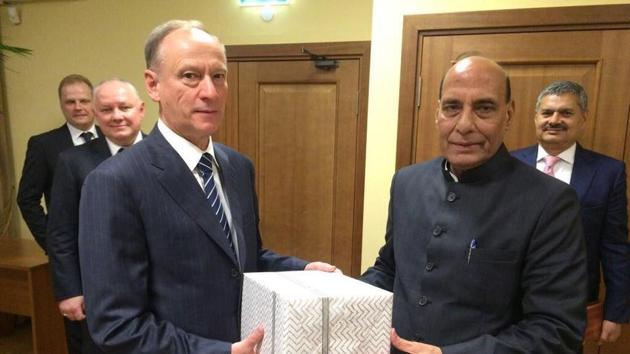
The agreement between the two countries for cooperation in tackling all forms of terrorism was signed by home minister Rajnath Singh and Russia’s interior minister Vladimir Kolokoltsev here after they held wide-ranging talks.
The ministers underlined that cooperation in the field of security is an important aspect of this bilateral relationship further strengthen cooperation to combat terrorism, extremism and radicalism, a statement issued by the Indian embassy said.
They agreed that terrorism must be fought unitedly and there were no good or bad terrorists, it said.
“The new agreement between India’s MHA and Russia’s interior ministry will replace the October 1993 agreement between both the countries. This agreement will help in expanding and deepening cooperation on issues related to internal security,” Singh tweeted after signing the pact.
The Indian embassy statement said the two leaders agreed to cooperate in combating new challenges, enhance exchange of information, cooperate in building a data base and in training of police and investigative agencies.
{{/usCountry}}The Indian embassy statement said the two leaders agreed to cooperate in combating new challenges, enhance exchange of information, cooperate in building a data base and in training of police and investigative agencies.
{{/usCountry}}Indian and Russian representatives also signed the joint action plan for countering the threat posed by narcotics and the agreement will provide legal framework for bilateral cooperation in this field.
The pact was signed by Indian ambassador to Russia Pankaj Saran and deputy minister for internal affairs of the Russian Federation Igor Zubov in presence of Singh and Kolokoltsev.
The agreement on internal security is an updated and more comprehensive agreement on cooperation on security between the MHA and the Russian ministry of interior.
This pact provides a comprehensive approach for help in security related issues, including information technology crimes, counterfeiting currency, illicit trafficking in narcotic drugs and psychotropic substances, trafficking in human beings, economic crimes, crimes related to intellectual property, cultural property amongst others, the statement said.
During the meeting, the ministers emphasised the strength of the relationship between India and Russia that has been consolidated in the past 70 years in all areas.
Before leaving for Russia, Singh said India and Russia share a special relationship which has withstood the test of time over the decades.
Singh was scheduled to visit Russia on September 18, 2016, but he had cancelled it following a terror attack on that day at the Brigade headquarters in Uri in Jammu and Kashmir, in which 19 Army soldiers were killed.
ABOUT THE AUTHOR
Follow the latest breaking news, major developments and agenda-setting stories from India and around the world with the newsdesk at Hindustan Times. Operating round the clock, the desk brings together experienced editors, reporters and correspondents to deliver fast, accurate and contextual reporting across subjects that influence public policy, governance, business, society and international affairs. The HT News Desk covers politics, elections, government policies, the economy, business and markets, science and technology, the environment, law and order, infrastructure, education, climate issues and geopolitics, while closely tracking developments across states, institutions and global capitals. The team also leads coverage of major breaking news events, policy announcements, court proceedings, natural disasters, public emergencies and significant international developments. Reports published by the newsdesk are based on information gathered from reporters on the ground, official statements, government agencies, court records, regulatory filings, recognised institutions and other authoritative sources. Stories undergo editorial scrutiny and verification processes to ensure accuracy, fairness and relevance, and are updated as events evolve and additional information becomes available. Whether covering a key political decision in New Delhi, an economic policy shift affecting millions, a landmark court ruling or a major global event, the HT News Desk aims to provide readers with reliable, fact-based journalism that delivers not only the latest developments but also the context and analysis needed to understand their wider implications.