India’s heaviest rocket – Geosynchronous Satellite Launch Vehicle-Mark III (GSLV-Mk III) – is set for its maiden flight into space along with a communications satellite GSAT-19 on Monday evening.
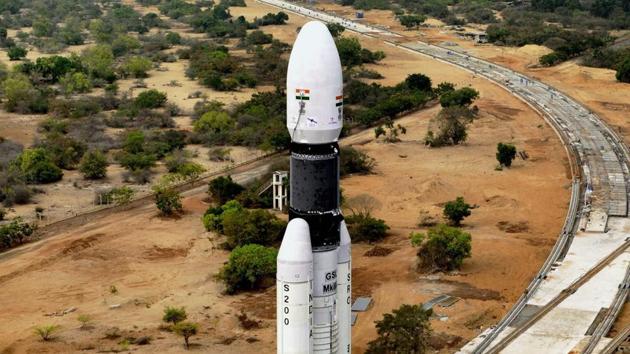
The countdown of 25 hours and 30 minutes began at 3.58 pm on Sunday, an official of the Indian space agency said.
The rocket, weighing 640 tonnes and standing 43.43 metres tall, will blast off from the second launch pad at India’s rocket port at Satish Dhawan Space Centre in Sriharikota in Andhra Pradesh, around 105 km from Chennai.
It will carry a 3,136-kg GSAT-19 communications satellite – the heaviest to be lifted by an Indian rocket till date – to an altitude of around 179 km above the Earth after just over 16 minutes into the flight.
On June 2, the Mission Readiness Review Committee and Launch Authorisation Board had cleared the countdown for GSLV Mk-III D1/GSAT-19 mission.
{{/usCountry}}On June 2, the Mission Readiness Review Committee and Launch Authorisation Board had cleared the countdown for GSLV Mk-III D1/GSAT-19 mission.
{{/usCountry}}The rocket’s main and bigger cryogenic engine has been developed by space scientists here.
The mission’s success will enable India to launch four-tonne satellites on its own rocket instead of paying huge amounts of money to foreign space agencies to execute the operation.
According to Indian Space Research Organisation, GSAT-19 with a life span of 10 years is a multi-beam satellite that carries Ka and Ku band forward and return link transponders and geostationary radiation spectrometer.
“The rocket’s design carrying capacity is four tonnes. The payload will be gradually increased in future flights of the GSLV Mk-III,” K. Sivan, Director, Vikram Sarabhai Space Centre, told IANS earlier.
The Indian space agency had flown a similar rocket without the cryogenic engine but with 3.7-tonne payload in 2014 mainly to test its structural stability while in flight and the aerodynamics.
S Somanath, director, Liquid Propulsion Systems Centre, told IANS that the inputs of the 2014 mission enabled the ISRO to reduce the rocket load by around 20 per cent.
Interestingly, GSLV-Mk III at around 43 metres is slightly shorter than Mk-II version that is around 49 metres tall.
“The new rocket may be slightly short but has more punch power,” an ISRO official told IANS.
India presently has two rockets -- the Polar Satellite Launch Vehicle and GSLV-Mk II -- with a lift-off mass of 415 tonnes and a carrying capacity of 2.5 tonnes.