India has rolled out nearly 23 million doses of Covid-19 vaccines to 20 countries around the world, both as grants and commercial supplies, and more will be sent to countries in Africa and Latin America in the coming weeks.
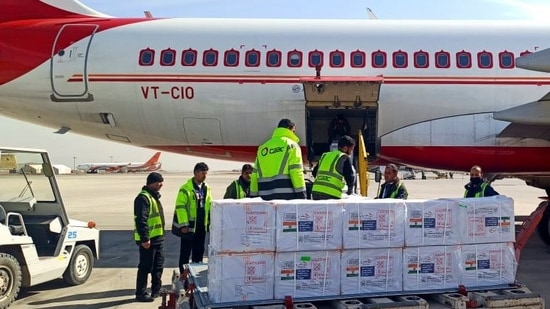
The supplies under the Vaccine Maitri initiative, which began on January 21, have earned India considerable goodwill, especially in small countries such as the Commonwealth of Dominica. Most leaders of countries that received vaccines as grants have noted that India was sending out supplies even as it undertakes the world’s largest inoculation drive.
Out of the total supplies, 6.47 million doses were given as grants while 16.5 million doses were provided as commercial supplies. Countries in India’s immediate neighbourhood were among the biggest beneficiaries, in keeping with the government’s “Neighbourhood First” policy.
The deliveries of Covishield, the AstraZeneca vaccine made by the Serum Institute of India, have helped India pull ahead of China in what is being referred to as “vaccine diplomacy”. Chinese vaccines have been approved by only a handful of countries in the region and China has so far offered vaccines only to Pakistan and Nepal.
“We will continue to take forward the global vaccine supply initiative and cover more countries in a phased manner. In the coming weeks, vaccines will be supplied to more countries in Africa, Latin America, CARICOM and Pacific Island states,” external affairs ministry spokesperson Anurag Srivastava told a news briefing on Friday.
{{/usCountry}}“We will continue to take forward the global vaccine supply initiative and cover more countries in a phased manner. In the coming weeks, vaccines will be supplied to more countries in Africa, Latin America, CARICOM and Pacific Island states,” external affairs ministry spokesperson Anurag Srivastava told a news briefing on Friday.
{{/usCountry}}Beyond India’s immediate neighbourhood, vaccines have been sent as grants to countries in the Indian Ocean region, West Asia and the Caribbean.
These countries include Bangladesh (two million doses), Myanmar (1.7 million doses), Nepal (one million doses), Bhutan (150,000 doses), the Maldives (100,000 doses), Mauritius (100,000 doses), Seychelles (50,000 doses), Sri Lanka (500,000 doses), Bahrain (100,000 doses), Oman (100,000 doses), Afghanistan (500,000 doses), Barbados (100,000 doses) and Dominica (70,000 doses).
The countries that received commercial supplies are Brazil (two million doses), Morocco (six million doses), Bangladesh (five million doses), Myanmar (two million doses), Egypt (50,000 doses), Algeria (50,000 doses), South Africa (one million doses), Kuwait (200,000 doses) and the United Arab Emirates (200,000 doses).
Srivastava declined to go into specifics on whether India will also provide vaccines to Canada, whose Prime Minister Justin Trudeau had taken up the issue with Prime Minister Narendra Modi during a phone call on Wednesday.
“Decisions on these supplies will, of course, be calibrated as per domestic production and the requirements of the national vaccination programme,” Srivastava said.
In the case of smaller countries such as the Commonwealth of Dominica, the Indian supplies will be adequate to inoculate almost half of the population of 72,000. The country is now planning its largest vaccination programme that will initially cover frontline workers, senior citizens, lawmakers and cabinet ministers.
Dominican Prime Minister Roosevelt Skerrit said he hadn’t imagined that the prayers of his country would be answered so swiftly. “Being the leader of a small Caribbean island with a population of 72,000 people, I did not fancy my chances of getting such a swift, positive response to my request of India’s Prime Minister Narendra Modi,” he said.
“One would have thought and understood that in a global pandemic such as this, a nation’s size and might would have been the primary considerations but it is to the credit of Prime Minister Modi that our request was considered on merit and the equality of our people was recognised,” he added.