India on Friday successfully test-fired Rudram 1, the tactical anti-radiation missile that the Indian Air Force can launch from its Sukhoi-30MKI fighter jets to take down enemy radars and surveillance systems. The missile has a launch speech of up to 2 Mach, twice the speed of sound, people familiar with the matter said.
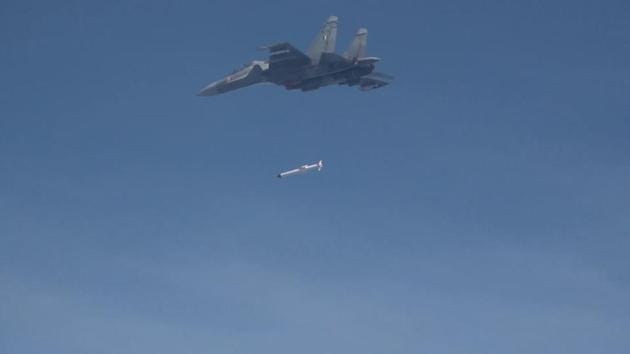
The Defence Research and Development Organisation developed the new generation weapon. It was tested at the interim test range Balasore, off the coast of Odisha in the Bay of Bengal, at about 10.30 am.
“This is a huge step forward,” a senior government official said about the DRDO’s successful test firing. “The IAF will now have the capability to perform SEAD (Suppression of Enemy Air Defence) operations deep into enemy territory to destroy enemy air defence setup,” the official said.
This would allow the IAF’s strike aircraft to carry out their mission unhindered effectively. “This test demonstrates the capability of an Anti-Radiation Missile with large stand-off ranges,” a second official said.
Watch l Watch: India test fires anti-radiation missile Rudram-1 l All you need to know
The New Generation Anti-Radiation Missile, or NGARM, is integrated on Su-30MKI fighter aircraft. Its range depends on the height at which the fighter jet is flying. It can be launched from a height ranging from 500 metres to 15 km and can hit radiation emitting targets within a range of 250 km.
{{/usCountry}}The New Generation Anti-Radiation Missile, or NGARM, is integrated on Su-30MKI fighter aircraft. Its range depends on the height at which the fighter jet is flying. It can be launched from a height ranging from 500 metres to 15 km and can hit radiation emitting targets within a range of 250 km.
{{/usCountry}}All radars and Electro Optical Tracking System tracked the launch and point of impact, a senior government official told Hindustan Times.
The tactical, air-to-surface anti-radiation missile is equipped with a passive homing head that tracks sources of radiation of a wide range of frequencies. It can lock into a target not only before launch but also after it has been launched.
Also Read: India launches Rudram missile. How do NGARMs work
The missile is comparable to the tactical air-to-surface missile AGM-88E Advanced Anti-Radiation Guided Missile that was inducted by the US Navy only in 2017 and can engage relocatable Integrated Air Defence targets and other targets equipped with shutdown capability. This means that if the enemy shuts down the radar after the missile is launched, it will still hit the target.
Defence Minister Rajnath Singh tweeted his congratulations to the DRDO team that developed the supersonic-capable missile that can be launched at speeds ranging from 0.6 Mach to 2 Mach.
“The New Generation Anti-Radiation Missile (Rudram-1) which is India’s first indigenous anti-radiation missile developed by DRDO for Indian Air Force was tested successfully today at ITR, Balasore. Congratulations to DRDO & other stakeholders for this remarkable achievement,” Rajnath Singh said on Twitter.