Prime Minister Narendra Modi's Mission Sudarshan Chakra or anti-ballistic missile shield is rapidly gaining momentum with DRDO expected to test-fire three interceptors under Project Kusha from 120 km to 400 km range in the next 12 months.
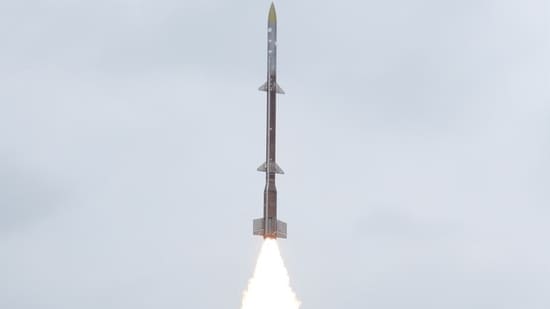
The Kusha missile system is capable of engaging threats across the 150-400 km range band
{{^htLoading}} {{/htLoading}}
On Thursday, the DRDO conducted maiden test-firing of the Kusha M-1 interceptor with a range of 120 kilometers off the coast of Odisha. Next to follow is the test firing of the M-2 interceptor with a range of 150 km and M-3 interceptor with the target range of 400 km. Project Kusha was cleared by the Cabinet Committee on Security in May 2022 but the project took off after Operation Sindoor when Pakistan targeted India with as many as 1000 projectiles. None of the missiles or the kamikaze drones found target in India and were successfully intercepted by the Akash Teer missile system.
{{^htLoading}} {{/htLoading}}
{{^usCountry}}
The three interceptors under Project Kusha are all long-range surface to air missile ready to take out any aerial threat towards India. The M-1, M-2 and M-3 interceptors, which will bridge the gap between Indian 80 km range medium range surface missile and the S-400 air defence system, will form the back-bone of the Indian anti-ballistic missile system.
{{/usCountry}}
{{#usCountry}}
The three interceptors under Project Kusha are all long-range surface to air missile ready to take out any aerial threat towards India. The M-1, M-2 and M-3 interceptors, which will bridge the gap between Indian 80 km range medium range surface missile and the S-400 air defence system, will form the back-bone of the Indian anti-ballistic missile system.
{{/usCountry}}
Project Kusha has been accorded top priority by the Narendra Modi government after Op Sindoor and Iran-US war showed that wars are going to be only fought using standoff weapons like missiles and drones. Since February 28, Iran has launched thousands of drones and missiles against all the Gulf countries and Israel and managed to hit targets despite anti-ballistic missile systems deployed by US-Israel and Gulf countries.
{{^htLoading}} {{/htLoading}}
Project Kusha has been accorded top priority by the Narendra Modi government after Op Sindoor
It was during Op Sindoor that the Indian armed forces felt the need of a LR-SAM to protect its fighting platforms and critical infrastructure. While the three interceptors are part of the kinetic force used against enemy missile and drones, Project Kusha is also about having long range radars which can pick up enemy missile firing across the border and prepare to neutralize the aerial threat.
{{^htLoading}} {{/htLoading}}
Given the criticality of anti-ballistic missile defence, India is looking forward to the fifth contracted S-400 system landing from Russia in November this year. Already work has begun on acquiring another five S-400 systems from Russia under the buy and make route and regulatory approvals will soon follow with India buying more than 280 S-400 missiles from Russia as part of its inventory.
Since Op Sindoor has not been called off, India is building its long range missile capability in case Pakistan again uses the terrorism card against India.
Shishir Gupta is Executive Editor at Hindustan Times and one of India's top journalists covering national security, strategic affairs, foreign policy and geopolitics. Over the past three decades, he has extensively reported on India's military, diplomatic and security landscape, covering every major conflict and national security challenge, from the 1999 Kargil War and the 2020 East Ladakh standoff to Operation Sindoor in 2025. He has also covered major terror attacks, including the IC-814 hijacking, the 26/11 Mumbai attacks and the 2025 Pahalgam terror strike, along with numerous Pakistan-backed terrorist incidents in the Kashmir Valley and across India. He has reported on national and state elections for more than three decades. A recognised authority on strategic affairs, Gupta has covered India's nuclear programme since the Pokhran-II (Shakti series) tests in May 1998 and has written extensively on global nuclear issues, Indian diplomacy and the country's expanding global outreach. He has also reported widely on international conflicts and terrorism, with a special focus on the Indian subcontinent. Gupta has interviewed Prime Minister Narendra Modi more than four times, including Modi's first interview with the print media after becoming Prime Minister in May 2014. His other interviews include three with the Dalai Lama, as well as conversations with Benjamin Netanyahu, Amit Shah, Yogi Adityanath, S. Jaishankar, Nirmala Sitharaman and Piyush Goyal. He is the author of Indian Mujahideen: The Enemy Within (Hachette, 2011) and Himalayan Face-off: Chinese Assertion and Indian Riposte (Hachette, 2014). He was awarded the Chevening-Wolfson Joint Scholarship at Wolfson College, University of Cambridge, UK, in 1998 and participated in the International Visitor Leadership Program (IVLP) of the US State Department in 2006. He received the Ben Gurion Prize from Israel in 2011 and the K. Subrahmanyam Prize for Strategic Studies in 2015 from the Manohar Parrikar Institute for Defence Studies and Analyses (MP-IDSA). Since 2024, he has hosted Point Blank, Hindustan Times' weekly YouTube show on global geopolitics.
Get the latest India News, breaking headlines and real-time updates from across the country. Stay informed about politics, government policies, crime, weather and major national developments.
Home/India News/India to test fire 3 Kusha interceptors as Mission Sudarshan Chakra acquires speed
{{^htLoading}}
Advertisement
{{/htLoading}}
SHARE THIS ARTICLE ON
{{#usCountry}}{{/usCountry}}
Hindustantimes wants to start sending you push notifications. Click allow to subscribe