China’s destabilising actions in the region figured at a meeting on Tuesday of the India-Vietnam joint commission on trade, economic, scientific and technological cooperation, during which the two countries agreed to work more closely together in the Indo-Pacific.
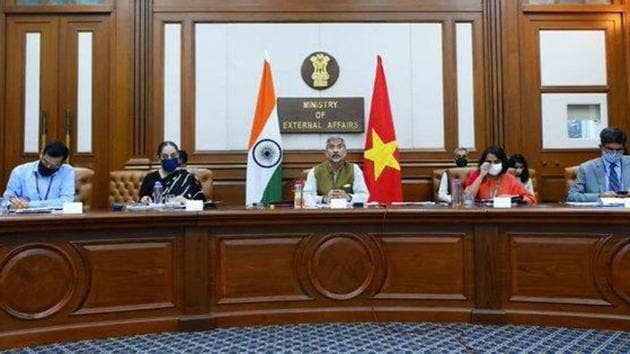
During the virtual meeting, co-chaired by external affairs minister S Jaishankar and his Vietnamese counterpart Pham Binh Minh, the two sides agreed to add new momentum to their economic and defence engagement and to explore closer cooperation in emerging areas such as civil nuclear energy, space, marine sciences and new technologies.
China’s actions in the South China Sea and along the Line of Actual Control (LAC) figured in the discussions, with both sides briefing each other on the latest developments, people familiar with developments said on condition of anonymity.
The Vietnamese side “underlined the importance of peace and security in the South China Sea”, one of the people cited above said.
India and Vietnam agreed to enhance bilateral cooperation in line with New Delhi’s Indo-Pacific Oceans Initiative (IPOI) and Asean’s outlook on Indo-Pacific to “achieve shared security, prosperity and growth for all in the region”, the external affairs ministry said in a statement. “India invited Vietnam to collaborate on one of the seven pillars of the IPOI,” it added.
IPOI was launched by Prime Minister Narendra Modi at the East Asia Summit in November 2019 and its pillars include enhancing maritime security, promoting free, fair and mutually beneficial trade and maritime transport and enhancing science and technology cooperation.
{{/usCountry}}IPOI was launched by Prime Minister Narendra Modi at the East Asia Summit in November 2019 and its pillars include enhancing maritime security, promoting free, fair and mutually beneficial trade and maritime transport and enhancing science and technology cooperation.
{{/usCountry}}In recent years, Vietnam has often turned to India for support over China’s increasing activities within its exclusive economic zone in the South China Sea. India is one of only three countries with which Vietnam has a comprehensive strategic partnership and state-owned ONGC Videsh is engaged in energy production in Vietnamese waters that have witnessed intrusions by Chinese vessels over the past year.
On Friday, Vietnamese envoy Pham Sanh Chau met foreign secretary Harsh Shringla to brief him on the escalating tensions in the South China Sea after China ramped up its military presence in the region.
At Tuesday’s meeting, the two sides also reviewed recent developments in their comprehensive strategic partnership and discussed the future trajectory of their engagement. The statement said Jaishankar and Minh “exchanged views on regional and international issues of mutual interest, especially in the context of the outbreak of Covid-19 pandemic”.
Jaishankar referred to the prime minister’s vision of “Atmanirbhar Bharat” for enhancing resilience through self-reliance and human-centric globalisation and invited Vietnam to take advantage of the country’s new economic capacities and demands.
He also reaffirmed India’s development and capacity-building aid to Vietnam through initiatives such as quick impact projects (QIPs), PhD fellowships, water resource management projects in the Mekong Delta, digital connectivity and heritage conservation. India has approved 12 QIPs in Vietnam, including seven water resource management schemes in the Mekong Delta and five for building educational infrastructure.
MoU for cooperation between the Sushma Swaraj Institute of Foreign Service and the Diplomatic Academy of Vietnam and between the National Maritime Foundation and Scientific Research Institute of Sea and Islands were signed on the margins of the joint commission meeting.
India and Vietnam also agreed to coordinate closely at multilateral forums, including the UN Security Council, where both countries will concurrently serve as non-permanent members in 2021, and at regional forums under the Asean framework.