India and Japan pledged to uphold a free and open world order in an “increasingly severe” global security environment and to deepen cooperation in key areas such as defence, technology, economic security, digital connectivity and security of AI systems as their defence and foreign ministers held their fourth 2+2 dialogue in Tokyo on Thursday.
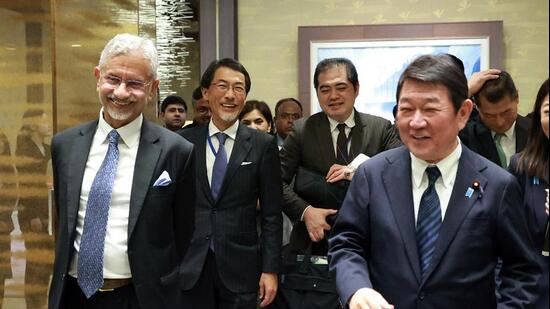
Defence minister Rajnath Singh and external affairs minister S Jaishankar’s talks with their Japanese counterparts, Shinjiro Koizumi and Toshimitsu Motegi, also led to progress in efforts to deepen cooperation on air and space domain awareness, a proposed information-sharing agreement, and collaboration on underwater and missile technologies.
The 2+2 meeting, held hours before a summit of the leaders of China, Russia and the US in Shenzhen, produced a joint statement that, without directly referring to China, opposed all attempt to unilaterally change the status quo, expressed grave concerns over economic coercion, including arbitrary export restrictions and non-market policies and practices, and backed a fair competitive global environment and resilient and reliable supply chains.
“This is an important relationship for peace and prosperity in the Indo-Pacific region,” Singh told a joint media interaction. Besides calling for early consideration of agreements related to the transfer of Japan’s Unified Complex Radio Antenna (Unicorn) system to the Indian Navy, Singh pressed for the early conclusion of a maritime ship repair arrangement and reciprocal provision of ship repair facilities between the two sides.
The ministers affirmed that India and Japan share a common responsibility to uphold a free and open global order based on rule of law in “an increasingly severe international security environment”, Japan’s foreign ministry said. Motegi said the two countries should serve as “an anchor for regional stability”, particularly in the Indo-Pacific, as the global security environment becomes increasingly uncertain.
{{/usCountry}}The ministers affirmed that India and Japan share a common responsibility to uphold a free and open global order based on rule of law in “an increasingly severe international security environment”, Japan’s foreign ministry said. Motegi said the two countries should serve as “an anchor for regional stability”, particularly in the Indo-Pacific, as the global security environment becomes increasingly uncertain.
{{/usCountry}}Jaishankar said the value of the trusted India-Japan partnership has increased at a time when the world order is facing multiple shocks, including two major conflicts, growing economic volatility and concerns about energy, trade, food and health security. Noting that the two countries are strong proponents of reformed multilateralism and committed to keeping the Indo-Pacific free and open, he said: “The big picture that our cooperation seeks to support is a multipolar Asia and a multipolar world.”
“We also spoke about a growing tendency to weaponise connectivity, resources, services, supply chains and market shares. Many of these have direct implications for our national security,” Jaishankar said, adding that India-Japan maritime cooperation can ensure that maritime trade functions smoothly as connectivity and chokepoints are impacted by the West Asia conflict.
A significant outcome of the meeting was the decision to accelerate coordination for the early realisation of a letter of intent (LOI) for the use of India’s firing ranges by Japan’s Self-Defence Forces to conduct live fire training, including the use of surface-to-ship missiles, the joint statement said. The two sides also agreed to further deepen cooperation in bilateral exercises by making them more complex, integrating unmanned systems and pursuing bilateral and multilateral drills at short notice.
The two sides expressed their expectation for the early formulation of arrangements related to the transfer of the Unicorn system, including the finalisation of the “Acceptance of Necessity” by India by February 2027. The two sides will also work to strengthen defence industrial cooperation under the framework of “Design with Japan, Make in India”.
Under the recently signed memorandum of arrangement on maritime security cooperation, the two sides agreed to focus on concrete outcomes between the Indian Navy and Japan’s Maritime Self-Defence Force in maritime and air domain awareness, search and rescue and information-sharing. Defence authorities will also work to enhance mine countermeasures capabilities and explore joint development in naval shipbuilding and design, the joint statement said.
The two sides further agreed to hold a dialogue between their consular authorities to discuss a range of consular-related matters, including holding a table-top exercise on cooperation in helping Indian and Japanese nationals abroad.
As part of efforts to strengthen secure and resilient digital connectivity in the Indo-Pacific, they agreed to enhance bilateral cooperation in developing trusted, redundant and high-speed undersea cable networks and to share best practices on the security, reliability and resilience of critical undersea communications infrastructure.
Following an increase in cyber attacks, the ministers agreed to strengthen cybersecurity cooperation, including in AI-enabled cybersecurity and security of AI systems. They directed their teams to renew the existing memorandum of cooperation in cybersecurity and convene the next edition of the India-Japan Cyber Dialogue at an early date.
The joint statement said the two sides strongly condemned all forms of terrorism and violent extremism, including cross-border terror, and sought concerted actions against all UN-listed terror groups such as al-Qaeda, Daesh, Lashkar-e-Taiba and Jaish-e-Mohammad and their proxies.
Motegi and Koizumi explained Japan’s ongoing efforts to revise its National Security Strategy, National Defence Strategy and Defence Buildup Program, which they said will contribute to enhanced cooperation with India to maintain peace and security in the region and beyond.