Prime Minister Narendra Modi on Monday said India’s decade-long shift to renewable energy had helped the country sustain high economic growth despite global disruptions, including the Covid-19 pandemic and the West Asia crisis.
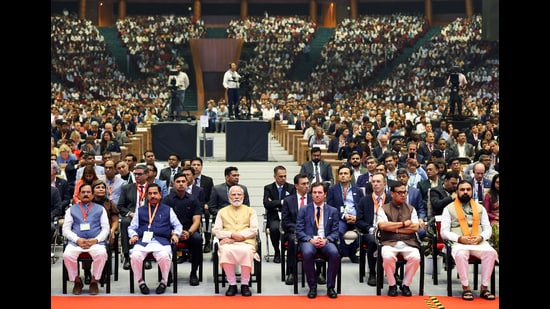
Inaugurating the Bharat Renewable Energy (BRE) Summit & Expo 2026 at Bharat Mandapam in New Delhi, Modi warned that continued over-reliance on fossil fuels would repeatedly disrupt the global economy. He said the future of energy security lay in clean energy and announced that India planned to install another 500 GW of non-fossil energy capacity over the next 10 to 11 years.
“The West Asia crisis is still ongoing. But 140 crore (1,400 million) Indians take pride in how effectively the nation has managed the turmoil while maintaining high economic growth,” Modi said in his inaugural address. He said a decade of sustained domestic investment and systemic reforms in clean energy had shielded India from severe external shocks.
“If India had not invested in clean energy and created new systems for this over the past decade, then our crisis could have been much more severe than the rest of the world,” he said.
{{/usCountry}}“If India had not invested in clean energy and created new systems for this over the past decade, then our crisis could have been much more severe than the rest of the world,” he said.
{{/usCountry}}Also Read | Supreme Court allows bursting of green firecrackers in Delhi on November 7-8; restores ban thereafter
Clean Energy Targets and International Support
Noting that the summit coincided with the ninth assembly of the International Solar Alliance and included delegates from the Fourth Conference on Green Hydrogen, Modi said fossil reserves were finite and concentrated in a few regions, unlike the boundless and universally accessible potential of clean energy. “We all know, the future of energy security lies in clean energy,” he said, describing India’s 12-year clean energy journey as one defined by promises, passion and performance, exemplified by its COP-26 commitment to achieve 500 GW of non-fossil capacity by 2030.
“We have fulfilled our Paris pledge of sourcing half of the installed power capacity from non-fossil sources in 2025 — five years ahead of schedule. India now ranks among the top three nations in solar and renewable energy, with over 50% non-fossil installed capacity and nearly 300 GW already achieved towards the 500 GW target,” Modi said.
“This target is somewhat difficult, but I have faith in the capability of my country; therefore I say, we will do it,” he said.
Modi said India remained committed to ensuring that funding, technology and expertise reached every country in need. “For Africa, a proposal for a $200 million Africa Solar Facility has also been put forward,” he said, adding that the coming decade was vital for global climate goals.
The four-day summit, which runs till November 5, 2026, will see participation from over 130 countries. India is targeting an investment of $220 billion in renewables by 2030. Multiple state chief ministers will also take part.
Also Read | Building green markets and integrated value-chains
Solar Programmes and Renewable Energy Access
Reviewing the PM Surya Ghar Muft Bijli Yojana, launched in February 2024 to install rooftop solar panels in one crore homes, Modi said over 6.5 million households had joined the programme within 24 to 25 months, at a pace of 100,000 new homes every six days. He said the scheme had cut electricity bills by roughly 76%.
Over the past 12 years, Modi said, more than 44,000 government buildings had been connected to solar energy, saving nearly ₹700 crore annually, while the KUSUM scheme had provided solar irrigation to over 3 million farmers.
Modi said India’s clean energy ecosystem extended beyond hydro, solar, wind and nuclear power, and was advancing rapidly under the National Green Hydrogen Mission, which aims to produce 5 million tonnes of green hydrogen by the end of the decade.
Power Transmission and Solar Use
He acknowledged that power generation must be matched by efficient distribution from high-production solar and wind zones to regions with lower output, so that homes, farms and industries across the country benefit equally. He referred to the Centre’s development of Green Energy Corridors, including transmission lines and substations supported by the ‘One Nation, One Power Grid’ network, which unified five regional grids onto a single frequency.
India has set a target of investing about ₹2 lakh crore to strengthen transmission infrastructure in the next phase, Modi said. He urged farmers to move beyond solar pumps and called for dedicated solar products to promote solar power in the dairy sector.
“For animal fodder, crop harvesting and post-harvest work, solar equipment should be developed for every such task,” he said.
Also Read | New Indian Air Force Chief Takes the Green Route, Switches to Electric Vehicle
India’s Wind Energy Potential
On the same day, a study released by The Energy and Resources Institute (TERI) highlighted India’s onshore wind potential of about 1,210 GW at a height of 150 metres, rising to about 2,934 GW at a 200-metre hub height. Offshore potential was estimated at around 220 GW at 150 metres and 277 GW at 200 metres, for wind speeds of 7.0 m/s and above, the study said.