The much-reported Indian acquisition of the United States' Predator drones is still to take off with the entire process at what is called 'pre-acceptance of necessity' (AON) stage, as the Narendra Modi government remains focused on achieving 'Aatmanirbhar Bharat' in the military hardware sector.
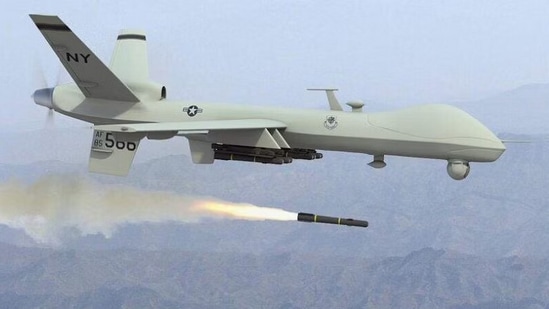
According to diplomats based in Washington, D.C. and New Delhi, the decision to move the proposal through the AON and Defence Acquisition Council (DAC) will be done only after the green signal from the government. The initial proposal was that India acquire 30 drones with reconnaissance, surveillance and hunting capabilities; the Army, Navy and Air Force would get 10 each for force application. Originally, the lead player in the acquisitions was the Navy, which already operates two surveillance versions of Predator drones from its base in Tamil Nadu for maritime domain awareness from the Gulf of Aden to the Sunda Straits beyond Malacca.
This week a report by news agency PTI quoted Dr Vivek Lall, CEO of General Atomics, as saying India is in 'advanced stage of negotiations' with the US for acquisition of 30 MQ 9B drones to crank up surveillance capabilities.
While the acquisition of the Predators - if it takes places - from the US through foreign military sales route will be a political decision, the era of armed drones has now dawned in the Indian sub-continent, with countries like China, Pakistan, Iran, the United Arab Emirates, Saudi Arabia, and Turkey equipped with these standalone weapon systems.
{{/usCountry}}While the acquisition of the Predators - if it takes places - from the US through foreign military sales route will be a political decision, the era of armed drones has now dawned in the Indian sub-continent, with countries like China, Pakistan, Iran, the United Arab Emirates, Saudi Arabia, and Turkey equipped with these standalone weapon systems.
{{/usCountry}}A proven and capable system, the Predator is prohibitively costly - the entire project will cost India upwards of $3 billion if approved.
It may be pointed out India is looking for an armed drone but would not like to spend huge amounts for purely a surveillance drone - a job done satisfactorily by the Israeli Heron upgraded drone for the Indian military at much cheaper costs.
Although the Modi government stands committed to developing armed drones through the indigenous route, the matter has acquired urgency with China developing armed drones with both turbo-prop and turbo-fan engines at a rapid pace. It has also supplied Pakistan with the armed turbo-prop version of Wing Loong II drones, while Islamabad is also looking towards Turkey for acquisition of much cheaper but effective Bayraktar TB 2 drone.
It is a matter of concern to India that Turkey, which still thrives on its Ottoman legacy of the past, is involved in upgrading Pakistani weapon systems including submarines.
India, in the meantime, has upgraded its Israeli Heron drones with better data link and force capability. It may not have a Predator in its arsenal but has the capability to take an unmanned aerial vehicle to fight the enemy.