Indonesia has agreed to give India economic and military access to the strategic island of Sabang at the northern tip of Sumatra and close to the Malacca Strait, an Indonesian minister said on Thursday.
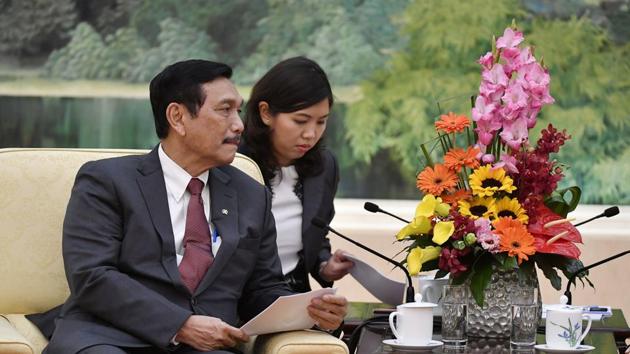
Luhut Pandjaitan, Indonesia’s coordinating minister for maritime affairs and a former military officer, said India will invest in the port and economic zone of Sabang and build a hospital.
He noted the port’s 40-metre depth is good for all types of vessels, “including submarines”. In time, he said, the coast guards of the two countries could also work together.
Sabang, also known as Weh island, is located 710 km southeast of the Andaman Islands and less than 500 km from the entrance of the Malacca Strait, through which almost 40% of India’s trade passes.
Pandjaitan made the remarks while speaking on India-Indonesia maritime cooperation at the Nehru Memorial Museum and Library in New Delhi, days ahead of Prime Minister Narendra Modi’s visit to Indonesia on May 31.
An Indonesian official accompanying Pandjaitan said his understanding was that besides development of the port, Indian naval ships would be allowed to visit Sabang under the understanding.
{{/usCountry}}An Indonesian official accompanying Pandjaitan said his understanding was that besides development of the port, Indian naval ships would be allowed to visit Sabang under the understanding.
{{/usCountry}}“It’s a verbal understanding at this stage. The Indonesian side will hold a meeting next week to seek ways to turn it into a reality,” said another official familiar with discussions on the issue.
An Indian diplomat, who didn’t want to be named, said the Sabang arrangement would “logically follow the Act East policy of the government”.
The Malacca Strait is considered one of six choke points, or narrow channels, along widely used global sea routes. They are critical for global energy security because of the high volume of oil transported through narrow straits. At least 15 million bpd of oil flows through the Malacca Strait from West Asia and West Africa.
India and Indonesia began exploring the idea of developing Sabang in 2014-15, said India’s former envoy to Indonesia, Gurjit Singh. However, the economic viability of the port was questioned.
Common concerns about Chinese assertiveness in the Indo-Pacific region have led both governments to again take up the island-port’s development.
Pandjaitan outlined the reasons for closer bilateral cooperation. He was critical of China’s Belt and Road Initiative, saying: “We do not want to be controlled by BRI.” He also questioned China’s unilateral claims on the South China Sea, noting this includes parts of Indonesia’s maritime exclusive economic zone.
Indonesia had positioned a plan called the “global maritime fulcrum” that is “designed to balance the BRI”, he said. Indonesia and India are big enough that “we don’t have to lean towards any superpower, and this makes India a sensible partner for Indonesia”, he added.
Pandjaitan said the two countries, which held naval exercises most recently in 2017, should also cooperate in counter-terrorism initiatives and maritime safety.
This marks a major shift in Indonesia’s attitude towards China and India. Until recently, Jakarta had been reluctant to seek strategic alignment with New Delhi and was in two minds about Beijing’s role in the region.
The Sabang arrangement will seal a new strategic partnership in the Indian Ocean. Admitting that Indonesia had ignored the Indian Ocean until recently, Pandjaitan said, “India and Indonesia relations are important to the balance of power in Asia.”