In their petition before the Supreme Court, Opposition leaders, including Mallikarjun Kharge and Rahul Gandhi, have alleged “unilateral and arbitrary exercise of the collective powers of the Election Commission of India (ECI) by chief election commissioner Gyanesh Kumar during the ongoing Special Intensive Revision (SIR) of electoral rolls.
The petition also sought a review of ECI’s key decisions to safeguard the constitutional guarantee of universal adult suffrage, alleging grave concerns “regarding the integrity of the electoral process” and “the infringement of the constitutional right of eligible citizens to be registered as voters and to exercise their right to vote.”
To be sure, the Opposition leaders said in the petition that they do not seek to reopen the question of the SIR’s validity. But they raised concerns whether the safeguards recognised by the Supreme Court, and the requirement that ECI act as a collective constitutional institution, have been complied with in the implementation of the exercise.
Deep Dive
What has the Opposition asked the Supreme Court to examine about the SIR?
Why is the Opposition seeking an independent audit of ECINET and ERONET?
Does the Opposition petition seek to pause the SIR and restore deleted voter names?
“The validity of the SIR does not dispense with the requirement that each decision taken in its implementation must conform to the Constitution, the governing statutes and the applicable Rules,” the petition said. HT has reviewed the petition.
On the deletion of 130 million names from India’s electoral rolls, the Opposition leaders asked for an effective and transparent verification mechanism. The petition also raised lingering concerns about the bulk filing of Form 7 objections, the alleged use of forged names and the targeting of specific communities and women, the denial of effective notice and hearing, and the lack of adequate enforcement against false declarations.
{{/usCountry}}On the deletion of 130 million names from India’s electoral rolls, the Opposition leaders asked for an effective and transparent verification mechanism. The petition also raised lingering concerns about the bulk filing of Form 7 objections, the alleged use of forged names and the targeting of specific communities and women, the denial of effective notice and hearing, and the lack of adequate enforcement against false declarations.
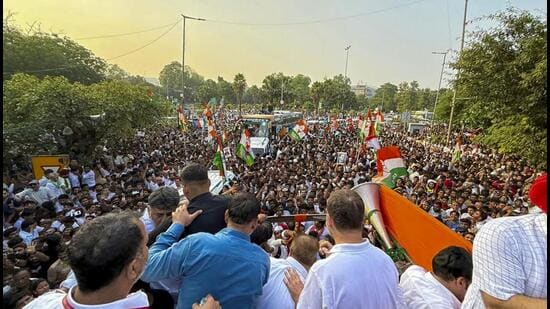
{{/usCountry}}Gandhi on Monday evening personally appeared at the Supreme Court to file the petition, joined by Kharge and nine other opposition leaders in a show of opposition unity over the SIR exercise and the alleged unilateral functioning of ECI.
The petition — which named the Election Commission of India, Kumar and two other election commissioners as respondents — was flagged for 14 defects, including a ₹220 shortfall in court fees, an illegible photocopy of Congress president Mallikarjun Kharge’s identity card and missing vakalatnamas for nine of the 11 petitioners. One of them was that a petition filed as a public interest litigation listed the three election commissioners by name as respondents.
The petition said it was filed to protect “the constitutional guarantee of universal adult suffrage and ensuring that the electoral process remains free, fair, transparent and accountable” and that “The right to vote belongs to every eligible citizen irrespective of political affiliation, and its protection is a constitutional imperative that transcends party politics.”
The synopsis of the petition refers to Chief Justice of India Surya Kant’s letter to Kharge and Gandhi, the Indian Express report on the two ECs raising 14 objections on the poll body’s SIR-related decisions, the allegedly opaque functioning of the ECINET and ERONET electoral-roll databases and the modifications to Form 6.
“The present petition arises from serious allegations concerning the functioning of the Election Commission of India during the implementation of the SIR, including the alleged exercise of the Commission’s collective powers by the Chief Election Commissioner without the knowledge, approval or concurrence of the other Election Commissioners; the absence of a recorded decision of the Commission authorising the nationwide SIR; the unlawful modification of the statutory Form 6 without amendment of the applicable Rules; the centralised and opaque functioning of the ECINET and ERONET electoral-roll databases; and the large-scale exclusion of electors without adequate notice, hearing or an effective mechanism for restoration,” it added.
The Opposition leaders have sought examination of the manner in which the ECINET and ERONET electoral-roll databases are designed, configured and operated. While the EC constituted an internal review panel headed by its Senior Deputy Election Commissioner, the Opposition leaders said that an internal review cannot substitute an independent audit of the electoral-roll databases, the access permissions governing them, the changes made to electoral records, and the safeguards available for reversing erroneous deletions.