
A grouping of six political parties in Jammu and Kashmir chose National Conference (NC) president Farooq Abdullah as its chairperson and Peoples Democratic Party (PDP) leader Mehbooba Mufti his deputy, giving shape to an alliance that they have formed to demand the restoration of the erstwhile state’s special status.
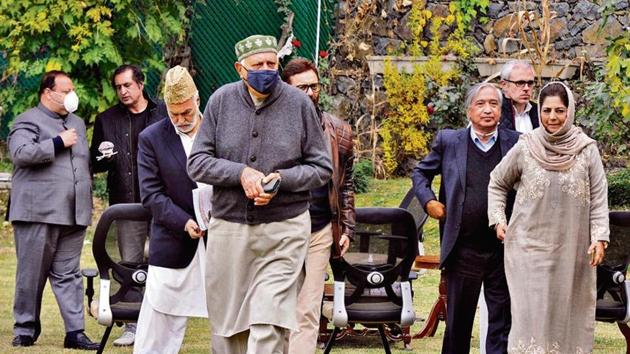
The decisions were taken at a meeting held at the Fairview residence of Mufti at the posh Gupkar Road in Srinagar. Leaders of all six parties — NC, PDP, Peoples Conference (PC), Communist Party of India-Marxist (CPI-M), Peoples Movement (PM) and Awami National Conference (ANC) — were present at the meeting. The flag of the erstwhile state was adopted as the flag of the alliance.
Abdullah said the grouping, christened People’s Alliance for Gupkar Declaration, or PAGD, was not an anti-national alliance but was definitely anti-Bharatiya Janata Party (BJP).
“I want to tell you that it’s a false propaganda by the BJP that the PAGD is anti-national. There is no doubt that it is anti-BJP, but it is not anti-national,” he said.
Abdullah, 84, the Lok Sabha member from Srinagar, said their fight was not religious in nature and that it was for their “rights and identity”. “They (the BJP) have tried to destroy the Constitution and divide the country. We have seen what they did to the Constitution of India on August 5 last year...our objective is to fight for the rights of people of Jammu, Kashmir and Ladakh. We will fight for the regional autonomy of Jammu and Ladakh regions as well.”
{{/usCountry}}Abdullah, 84, the Lok Sabha member from Srinagar, said their fight was not religious in nature and that it was for their “rights and identity”. “They (the BJP) have tried to destroy the Constitution and divide the country. We have seen what they did to the Constitution of India on August 5 last year...our objective is to fight for the rights of people of Jammu, Kashmir and Ladakh. We will fight for the regional autonomy of Jammu and Ladakh regions as well.”
{{/usCountry}}On August 5, 2019, the central government nullified Article 370, which accorded special status to the state of J&K, and bifurcated it into two Union territories – J&K with a legislative assembly and Ladakh without one — triggering widespread protests and a political firestorm.
Several political leaders and activists including three former chief ministers — Mufti, Abdullah and his son, Omar Abdullah — were detained as a preventive measure to maintain law and order. The Abdullahs were released in March, and Mufti was freed in the second week of October.
Since then, the leaders, once fierce opponents, have come together — backed by four other parties — to forge the alliance that aims to work for the restoration of the region’s special status. The grouping’s first meeting was held at the Gupkar residence of Abdullah on October 15.
At Saturday’s meeting, PC chairperson Sajjad Lone was nominated as the spokesperson of the alliance. CPI-M general secretary Mohammad Yusuf Tarigami will be its convener and Anantnag parliamentarian Hasnain Masoodi of the NC its coordinator. Members of the alliance said they will come up with a white paper within a month to expose the “lies” spread about the people of J&K.
“...it (the white paper) will be placed before the people and the country to expose lies and misunderstandings; it will expose the reality about J&K with statistics. The document will be a tribute to the people,” Lone said.
The next gathering of the alliance will be held in Jammu within two weeks and its first convention in Srinagar in November, he added.
BJP spokesperson Altaf Thakur said the grouping will not succeed. “These people have ruled J&K for 70 years. Now when they are out of power, the families have again come together to grab power. This is a VVIP alliance of powerful people that will not work.”
Noor Baba, a political analyst and the former head of the political science department at the Kashmir University, however, said leaders of the new alliance were a recognised and a significant voice. “The government of India cannot dub them separatists. They cannot be dubbed Pakistanis because their credentials are established as authentic Indians in Kashmir who believe in a certain idea of India — which is secular and allows certain safeguards in relation to the state of Jammu and Kashmir...Their voice is significant if they stand by what they have committed,” he said.
ABOUT THE AUTHOR
Follow the latest breaking news, major developments and agenda-setting stories from India and around the world with the newsdesk at Hindustan Times. Operating round the clock, the desk brings together experienced editors, reporters and correspondents to deliver fast, accurate and contextual reporting across subjects that influence public policy, governance, business, society and international affairs. The HT News Desk covers politics, elections, government policies, the economy, business and markets, science and technology, the environment, law and order, infrastructure, education, climate issues and geopolitics, while closely tracking developments across states, institutions and global capitals. The team also leads coverage of major breaking news events, policy announcements, court proceedings, natural disasters, public emergencies and significant international developments. Reports published by the newsdesk are based on information gathered from reporters on the ground, official statements, government agencies, court records, regulatory filings, recognised institutions and other authoritative sources. Stories undergo editorial scrutiny and verification processes to ensure accuracy, fairness and relevance, and are updated as events evolve and additional information becomes available. Whether covering a key political decision in New Delhi, an economic policy shift affecting millions, a landmark court ruling or a major global event, the HT News Desk aims to provide readers with reliable, fact-based journalism that delivers not only the latest developments but also the context and analysis needed to understand their wider implications.