If one wishes to understand the almost schizophrenia-inducing inequality that defines contemporary urban India, one need only read the newspapers from a single twenty-four-hour cycle in the National Capital Region. On the surface, these reports appear as disconnected tragedies and bureaucratic triumphs. Yet, when woven together, they form a damning, cohesive indictment of our urban governance, revealing a society fracturing into fortified islands of extreme privilege amidst a sea of lethal municipal neglect.
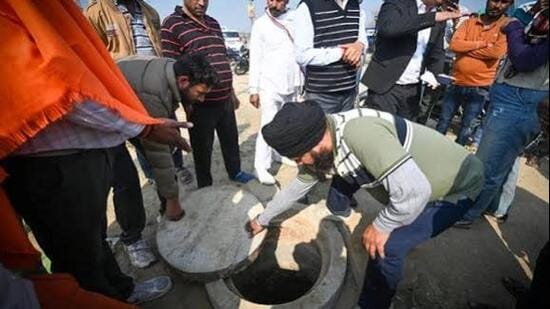
Consider the grim ledger of November 10. In Outer Delhi’s Ranhola area, four-year-old Imran vanished into the depths of a 50-foot-deep open sewer. The manhole, situated at a Delhi Jal Board site, was inadequately fenced, with its opening concealed by nothing more than a flimsy fibre sheet that gave way beneath a child’s weight. Following a frantic search, the child’s mutilated remains were recovered over three kilometres away at the Nilothi water treatment plant.
On that same afternoon, in Gurugram’s Sector 71, another preventable tragedy unfolded. Two twelve-year-old girls, Sajan Kumari and Naina, belonging to a rural settlement abutting a sprawling, under-construction luxury residential society, slipped through a gap in a poorly maintained corrugated iron boundary fence. They drowned in an artificial pond constructed to adorn the pristine greens of a private golf course.
There is a tragic symmetry in these two incidents. In both cases, children from the socio-economic margins lost their lives because the basic, elementary architecture of safety—a solid wall, a secure manhole cover, a warning sign—was deemed too insignificant to enforce. Official data tabled in the Delhi Assembly reveals a staggering indictment of civic apathy: in just two years, between 2024 and 2025, 89 citizens died across the national capital after falling into open drains or waterlogged underpasses. That is nearly four human lives snuffed out every single month—not by natural disasters, but by administrative callousness. Meanwhile, in the gleaming private enclaves of the Millennium City, ultra-luxury condominiums featuring manicured golf courses and decorative water bodies coexist cheek-by-jowl with impoverished villages, separated only by porous walls that fail to protect the vulnerable from the hazards of elite leisure.
{{/usCountry}}There is a tragic symmetry in these two incidents. In both cases, children from the socio-economic margins lost their lives because the basic, elementary architecture of safety—a solid wall, a secure manhole cover, a warning sign—was deemed too insignificant to enforce. Official data tabled in the Delhi Assembly reveals a staggering indictment of civic apathy: in just two years, between 2024 and 2025, 89 citizens died across the national capital after falling into open drains or waterlogged underpasses. That is nearly four human lives snuffed out every single month—not by natural disasters, but by administrative callousness. Meanwhile, in the gleaming private enclaves of the Millennium City, ultra-luxury condominiums featuring manicured golf courses and decorative water bodies coexist cheek-by-jowl with impoverished villages, separated only by porous walls that fail to protect the vulnerable from the hazards of elite leisure.
{{/usCountry}}Confronted with this systemic collapse of public infrastructure, India’s affluent classes have largely abandoned the idea of demanding civic accountability. Instead, they are retreating behind high walls to construct private fortresses, attempting to buy their way out of municipal failure. In Gurugram’s upscale gated colonies, Resident Welfare Associations possess private budgets that dwarf the allocations of small municipalities. When the winter air turns toxic, these enclaves deploy their own fleets of anti-smog mist cannons to spray fine water droplets over manicured lawns, while residents glide along spotless internal avenues on private e-scooters. It is a seductive, insular illusion: the belief that if one’s gated community is clean, the decay beyond the security barrier ceases to exist.
Yet, the ultimate insulation from urban India’s collapse is not found in private real estate, but within the manicured avenues of Lutyens’ Delhi. Barely forty-eight hours after little Imran fell into an uncovered sewer in Outer Delhi, the New Delhi Municipal Council (NDMC)—the tiny, gilded enclave housing India’s political, bureaucratic, and diplomatic elite—was proudly declared the second cleanest city in India among mid-size urban bodies in the Swachh Survekshan rankings.
The contrast is so stark it borders on the grotesque. Serving a resident population of under three lakh, the NDMC operates like a first-world oasis in the heart of a struggling metropolis. Here, there are no open sewers waiting to swallow toddlers, no towering, toxic mountains of rotting garbage, and no overflowing drains. Instead, this privileged conclave deploys a formidable mechanised arsenal: 11 mechanical road sweepers, 20 specialised gobbler machines, night-time sweeping squads, eight Micro Material Recovery Facilities, and a waste-processing capacity of over 500 tonnes per day that comfortably exceeds the 300 tonnes it generates.
When the powerful live in an air-conditioned, mechanically swept bubble where municipal perfection is guaranteed by the state, what urgency can they possibly feel to fix the rot in Ranhola, Najafgarh, or Fazilpur? This brings us to a fundamental, troubling question: whither urban India, when the very capital of the nation presents such a fractured, morally indefensible picture? A great city is not defined by the opulence of its golf courses, the efficiency of its VIP zones, or the height of its luxury towers. The true measure of a society lies in how it treats its most vulnerable citizens and the dignity it affords to its shared public spaces.
We cannot build a world-class nation on the foundation of municipal apartheid. Private mist cannons cannot permanently thwart engulfing pollution, and high walls cannot erase the social consequences of municipal neglect. Until the death of a four-year-old boy in an open drain sparks the same administrative urgency as a cleanliness award in Lutyens’ Delhi, our urban future will remain a glittering façade built precariously over an open sewer.
One small point: “under three lakh” is more natural in Indian English than “under three lakhs”; otherwise, the changes are limited mainly to grammar and British spelling, as requested.
Would you like me to also do a second, more rigorous edit for repetition, rhythm and argumentative flow, while preserving your voice and marking every change in bold?
Pavan K Varma is an author, diplomat, and former member of Parliament (Rajya Sabha). The views expressed are personal