
 E-Paper



Just Like That: Sabarimala temple debate on faith, equality and path to reform
Women’s entry at Sabarimala remains contested as society navigates between age-old religious customs and India’s commitment to equality

 Prefer HTon Google


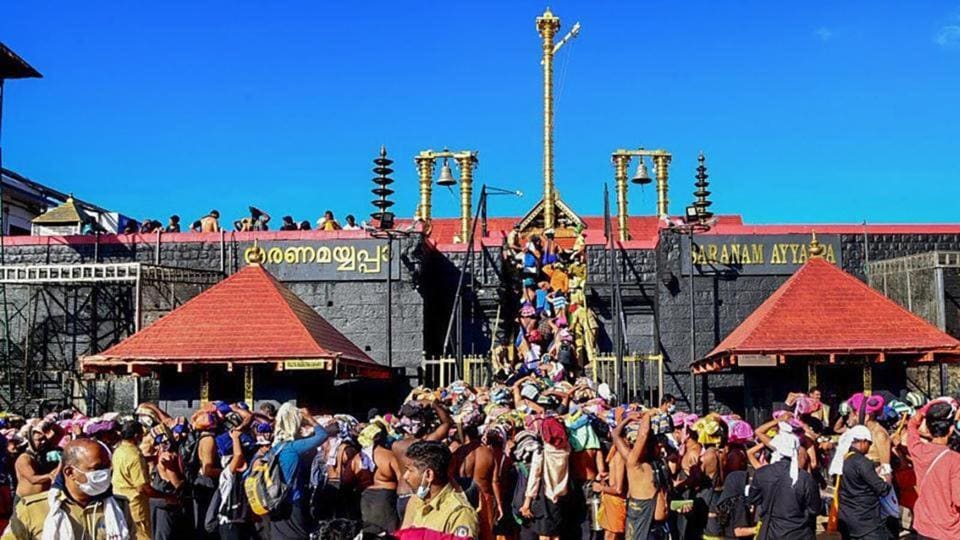
Last week, at the conclave of a national TV channel, I was in an interesting debate on the question of religious customs and traditions, and the right to change them, either by citizens themselves or through the intervention of the state or the judiciary. Specifically, much of the discussion focused on the question of the entry of girls and women between the ages of ten and fifty at the Sabarimala temple.
I have been a life-long student of Hindu philosophy. For me, as a general rule, spirituality unites, and religion—in its practice—often divides. For instance, as per the Advaita or Vedantic doctrine—perhaps the most powerful school of Hindu philosophy—there can be no hierarchy or exclusion between human beings because the same cosmic consciousness is in all of us. In the 8th century, when the disciples of Adi Shankaracharya sought to remove a ‘chandala’ or so-called ‘untouchable’ from his vicinity, the chandala himself questioned the great philosopher on how this was legitimate when the same Brahman was both within him and in Adi Shankaracharya. It is said that the sage then composed the five-verse Manishapanchakam on the spot. Each stanza ended with the line: Chandala stu sa dvijo stu, gururityesha manisha mama: a person may be a chandala or a twice-born (upper caste); for me, both are gurus—this is my solemn resolve.
I think this incident has a bearing on the Sabarimala matter. The Supreme Court of India, in its landmark judgment of 2018, held that the exclusion of women of menstruating age from the shrine of Lord Ayyappa was unconstitutional. Yet, the matter refuses to settle. Review petitions have been filed, and society remains divided between reverence for tradition and the call for reform.
At first glance, the defenders of the ban invoke religious custom. They argue that Lord Ayyappa is an eternal naisthika brahmachari—a celibate ascetic—and that the presence of women of reproductive age is incompatible with the sanctity of this vow. According to them, the centuries-old practice of barring women between 10 and 50 is intrinsic to the character of the shrine, and therefore protected under the freedom of religion guaranteed by the Constitution.
But this argument raises a larger question: is religious custom sacrosanct forever?
Indian history suggests otherwise. Religion in India has never been a frozen edifice. It has evolved continuously through introspection, reform, and reinterpretation. Consider the practice of sati, where widows were compelled or persuaded to immolate themselves on the funeral pyres of their husbands. For centuries, it was defended by its supporters as a sacred duty rooted in scriptural sanction. Yet determined opposition by reformers such as Raja Ram Mohan Roy led to it being outlawed in 1829.
Similarly, temple entry itself was once denied to so-called untouchables. The struggle against this injustice was long and arduous, leading eventually to the Temple Entry Proclamation, which threw open temples in Travancore to all Hindus regardless of caste.
The cause of women’s dignity, too, found champions in India’s reformist tradition. The campaign for widow remarriage, for instance, was spearheaded by visionary reformers such as Ishwar Chandra Vidyasagar. Through his efforts, the Hindu Widows’ Remarriage Act of 1856 was enacted, transforming the lives of countless women who had been condemned to a life of social death.
The case of Sabarimala must therefore be seen in this broader historical context. The exclusion of women between 10 and 50 is based on the notion that menstruation renders them impure, or that their presence disturbs the celibate austerity of Lord Ayyappa. Yet such reasoning sits uneasily with the spiritual philosophy that underpins Hinduism itself.
Moreover, the argument that the presence of women would defile the vow of a deity seems philosophically tenuous. Can the spiritual power of a divine being be so fragile that it is threatened by the mere presence of women? Faith, if it is genuine, should inspire confidence rather than insecurity.
It is also important to remember that the Indian Constitution enshrines equality as a foundational principle. Articles guaranteeing equality before the law and prohibiting discrimination on grounds of sex are part of our fundamental rights. When religious practices conflict with these constitutional values, society must ask whether such practices deserve continued protection.
Yet law alone cannot resolve what is essentially a social and cultural question. For many devotees, Sabarimala is not merely a temple but a deeply cherished tradition. The annual pilgrimage, with its arduous trek and strict vows of austerity, fosters a powerful sense of spiritual community. To dismiss the anxieties of devotees as mere obscurantism would be both unfair and counterproductive.
Reform in India has rarely succeeded through confrontation alone. It has required dialogue, persuasion, and the gradual reshaping of social attitudes. The Sabarimala controversy should therefore be approached with sensitivity as well as firmness. Devotion deserves respect, but discrimination cannot be defended in its name.
India’s civilisational history offers a clear answer. Time and again, when confronted with the choice between rigid orthodoxy and humane reform, the nation has moved—sometimes slowly, sometimes reluctantly—towards greater justice. The Sabarimala debate is another chapter in that long journey. Faith need not fear equality. Indeed, when religion embraces the dignity of every human being, it acquires a deeper and more enduring sanctity.
(Pavan K Varma is an author, diplomat, and former member of Parliament (Rajya Sabha). The views expressed are personal)


