Supreme Court judge Sanjiv Khanna on Saturday underlined that the judiciary’s true measure is not found in the grandeur of the court rooms or technological advancements but in its capacity to deliver justice with compassion, empathy and fairness.
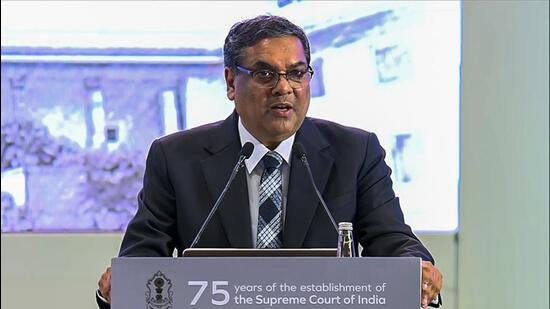
Speaking before a distinguished audience including Prime Minister Narendra Modi, justice Khanna set the tone for the National Conference of the District Judiciary, highlighting the pivotal role of district courts in the Indian judicial system.
“Ultimately, it is not the grandeur of the courtrooms or the sophistication of our technology that will define us...Rather, we will be defined by our unwavering commitment to delivering justice by enhancing access to justice, serving the people with compassion, empathy, and fairness,” he emphasised.
Justice Khanna, who is set to assume office as Chief Justice of India on November 11, 2024 for a term of six months, reflected on his own journey through the judicial ranks. He expressed deep gratitude for the district judiciary, acknowledging its crucial, yet often under-appreciated, role.
“In the expanse of the judicial hierarchy, the district judiciary often finds itself overshadowed by the high courts and the Supreme Court...Yet, in 2023, our district courts handled more than ten times the cases of the high courts. If we were to evaluate the importance of the role of different functionaries in the administration of justice, the top position would necessarily have to be assigned to the district court judges,” he said.
{{/usCountry}}“In the expanse of the judicial hierarchy, the district judiciary often finds itself overshadowed by the high courts and the Supreme Court...Yet, in 2023, our district courts handled more than ten times the cases of the high courts. If we were to evaluate the importance of the role of different functionaries in the administration of justice, the top position would necessarily have to be assigned to the district court judges,” he said.
{{/usCountry}}Justice Khanna highlighted that it is mostly the district court judges that the members of the general public come in contact at the first level. “Thus, the image of the judiciary for the common man is projected by our district court judges,” he pointed out.
Justice Khanna praised recent advancements in the district judiciary, noting significant improvements in case disposal rates. The disposal rate of civil cases, he cited, soared from 93.15% in 2018 to an impressive 99.61% in 2023. Similarly, the disposal rate for criminal cases increased from 86.65% to 95% over the same period. He highlighted that in 2023, 71.82% of criminal cases were resolved within a year, reflecting the efficiency and dedication of the district judiciary.
The judge also acknowledged that the judiciary is faced with the problem of pendency and backlog of cases, adding that a more efficient functioning of the district judiciary is crucial to mitigating these challenges.
Justice Khanna emphasised the importance of innovative strategies to manage case backlog and improve efficiency. “Judicial impact assessment, a much discussed strategy for case management, can be a powerful tool in assessing and enhancing human resources and infrastructure in the judiciary,” he said.