With public transport services disrupted across Karnataka on Tuesday, the high court issued a stern warning to protesting transport employees, criticising the continuation of their agitation despite a court directive and the invocation of the Essential Services Maintenance Act (ESMA). The court’s strong response prompted the Karnataka State Road Transport Corporation (KSRTC) Staff and Workers’ Federation to suspend the strike until Thursday, when the matter is scheduled to be heard again.
A division bench of chief justice Vibhu Bakhru and justice CM Joshi, while hearing a public interest litigation (PIL), expressed serious displeasure over the trade unions’ defiance of its interim order. The judges made it clear that the court would not tolerate ongoing disruption and warned of potential contempt proceedings if the strike continued.
“If you have grievances, resolve them through dialogue with the government. You cannot inconvenience the public. Continuing the strike even after ESMA has been invoked is illegal,” the bench observed during the hearing.
The PIL, filed by Sunil J and four others and represented by advocate Deeksha N Amrutesh, sought the court’s intervention to prevent hardship to commuters. The court had earlier instructed the unions to postpone the proposed indefinite strike, initially planned to begin on Tuesday. However, the strike still went ahead, prompting the court to extend its interim stay on the agitation for two more days and demand an affidavit confirming the strike’s suspension.
The ongoing agitation was driven by employee demands for a 25% hike on a base pay of ₹1,124, along with 38 months’ worth of arrears, amounting to an estimated ₹1,800 crore. While chief minister Siddaramaiah offered to release arrears for 14 months and called upon the unions to end the strike, the unions rejected the proposal, insisting they deserved full payment for all 38 months.
{{/usCountry}}The ongoing agitation was driven by employee demands for a 25% hike on a base pay of ₹1,124, along with 38 months’ worth of arrears, amounting to an estimated ₹1,800 crore. While chief minister Siddaramaiah offered to release arrears for 14 months and called upon the unions to end the strike, the unions rejected the proposal, insisting they deserved full payment for all 38 months.
{{/usCountry}}The court on Tuesday orally cautioned that leaders of the Joint Action Committee (JAC), which represents employees from all four state-run transport corporations — KSRTC, BMTC, NWKRTC and KKRTC — could face arrest under ESMA provisions if the strike resumed. Notices were also issued to the unions, and the court reiterated that the public must not be held hostage by such protests.
“Has the strike been suspended today? The strike is illegal. Police have already arrested anybody who is supporting the strike? Whatever you (trade unions) do (do it) in accordance with the law. As of now, the strike is illegal. If you have issues, you can negotiate with the government. You can’t hold the public for ransom, but that is exactly what the unions are doing. The public can’t be inconvenienced in this manner,” the court remarked.
Responding to the court’s observations, JAC’s legal counsel assured that the strike would not continue on Wednesday and that workers would resume duties. Shortly after the hearing, KSRTC Staff and Workers’ Federation president HV Anantha Subbarao addressed a press conference to announce the suspension of the agitation. “After receiving clear directions from the Hon’ble Court, we have withdrawn the strike and appealed to all workers to resume duty,” he said.
Subbarao also urged management not to punish employees who had participated in the protest. “We urge the management not to resort to any form of victimisation,” he added.
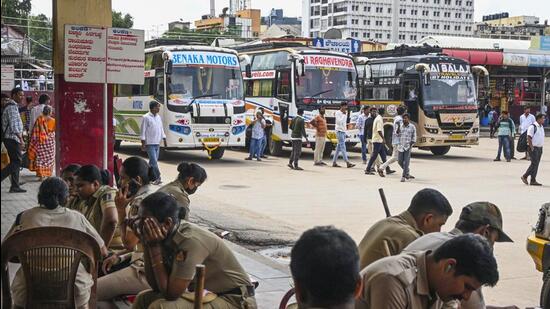
On the ground, public transport in Karnataka remained patchy on Tuesday. In Bengaluru, the state government claimed that BMTC services were operational, but ridership in districts was reportedly at 50%. In Bengaluru Shivajinagar Bus Stand showed limited services, and there was heavy commuter rush at Majestic Metro Station due to increased reliance on the Namma Metro. Areas in Kalyana Karnataka and North-West Karnataka bore the brunt of the strike.