
Prime Minister Imran Khan on Tuesday claimed Pakistan was needlessly blamed for the Pulwama attack in February, which he said was carried out by a local disaffected Kashmiri and the Jaish-e-Mohammad that took responsibility also operated in India. Pakistan was blamed without a reason.
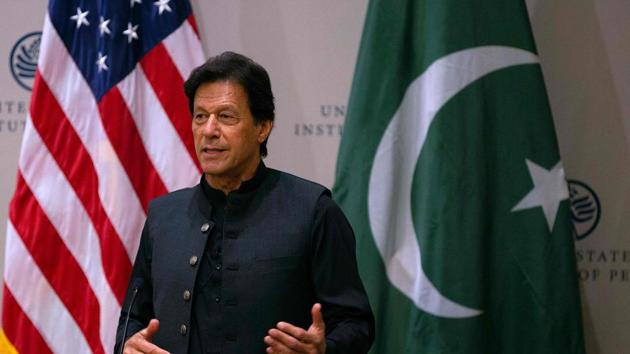
He said in response to a question if the current crackdown on terrorists and militants in Pakistan would continued and if Hafiz Saeed, whose arrest for the eight time impressed only the US president Donald Trump, would stay in custody this time, and not be released as in previous instances.
Khan tried first to make light of the question that while the country wants and needs an independent judiciary he is being asked to predict what it would do. Without directly answering the Saeed arrest question, he said it was in Pakistan’s interest to now get rid of all armed militias.
“It is in Pakistan’s interest, it’s in our interest,” he continued. “The country has had enough of militant groups.”
The prime minister said the security forces were with him on this. “It’s the army that’s helping us disarm all militant groups.”
{{/usCountry}}The prime minister said the security forces were with him on this. “It’s the army that’s helping us disarm all militant groups.”
{{/usCountry}}“It was clearly an indigenous thing,” Khan went to say at a think tank, US Institute of Peace, referring to the Pulwama attack that took place in Kashmir. “It was a Kashmiri boy radicalized by the brutality the security forces. He blew himself up. But because this group claimed responsibility, which was in India as well, Jaish-e-Mohammad is operating in India — but Pakistan suddenly came in the limelight.”
ABOUT THE AUTHOR
Follow the latest breaking news, major developments and agenda-setting stories from India and around the world with the newsdesk at Hindustan Times. Operating round the clock, the desk brings together experienced editors, reporters and correspondents to deliver fast, accurate and contextual reporting across subjects that influence public policy, governance, business, society and international affairs. The HT News Desk covers politics, elections, government policies, the economy, business and markets, science and technology, the environment, law and order, infrastructure, education, climate issues and geopolitics, while closely tracking developments across states, institutions and global capitals. The team also leads coverage of major breaking news events, policy announcements, court proceedings, natural disasters, public emergencies and significant international developments. Reports published by the newsdesk are based on information gathered from reporters on the ground, official statements, government agencies, court records, regulatory filings, recognised institutions and other authoritative sources. Stories undergo editorial scrutiny and verification processes to ensure accuracy, fairness and relevance, and are updated as events evolve and additional information becomes available. Whether covering a key political decision in New Delhi, an economic policy shift affecting millions, a landmark court ruling or a major global event, the HT News Desk aims to provide readers with reliable, fact-based journalism that delivers not only the latest developments but also the context and analysis needed to understand their wider implications.