June 1 this year marked 90 years since the iconic Prabhat Film Company was established. For the uninitiated, some of the best Marathi films such as Ayodhyecha Raja, Sant Tukaram, Sant Dnyaneshwar, Manoos and Shejari, among others, were produced by the now-defunct cinema giant.
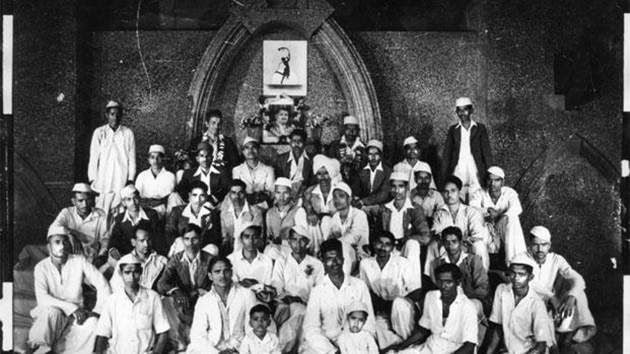
Kin of the founding members — S Fatehlal, Vishnupant Damle, Sitaram Kulkarni, K Dhaibar and V Shantaram — gathered on Saturday at Studio No. 1 on Film and Television Institute of India (FTII) campus, which was the main studio of the Prabhat Film Company, to revive memories of India’s most lucrative film company.
The studio, which now serves FTII students, continues to spread cinematic knowledge through its 90-year legacy. The Prabhat Film Company was established on June 1, 1929, in Kolhapur.
“I remember playing on the film trolley, rolling downhill from Shantaram pond to the main gate,” said Subhash Kulkarni, who used to accompany his father Sadashiv Kulkarni, who worked for the Prabhat Film Company as a recording engineer since 1929. “I grew up here. When I was 10 years old, I once even slept in the recording studio when my father was working on a music piece by Sudhir Phadke. Completely oblivious of me even being there, he left the studio. He later came back looking for me,” added the 72-year-old architect.
For Mahadev Ambekar, a civil contractor, it was a matter of pride to visit the studio which created masterpieces of Indian cinema. “My grandfather Dadasaheb Ambekar built the studio as the contractor and when I look it at now, I feel proud to see its design,” he said.
{{/usCountry}}For Mahadev Ambekar, a civil contractor, it was a matter of pride to visit the studio which created masterpieces of Indian cinema. “My grandfather Dadasaheb Ambekar built the studio as the contractor and when I look it at now, I feel proud to see its design,” he said.
{{/usCountry}}The entire Damle clan was present at the studio, the oldest was Jayant Damle, son of Vishnupant Damle. Hard of hearing, the 83-year-old used to spend most of his days after school at the film studio. “It was like our second home. Every day after school, I would be at the studio, watching and helping with the shoot. I was born in 1936, when the film Sant Tukaram was released, so unlike my other cousins, I didn’t really get to act in front of the camera. I loved music and also played the sitar, but never really worked within the film industry. I studied metallurgy and then, career took a different route,” said Jayant.
Vijay Damle (77), whose father Shankarrao Damle (a relative of Vishnupant Damle) handled the recording studio, recalls coming to the studio since the age of 3.
“My basic swimming lessons began at the Shantaram pond. Being a part of the studio, I learnt radio repairing to recording songs, all on the set.”
Similarly, his brother Shashikant Damle, too, enjoyed each second spent at the studio. “My father maintained the equipment inside the studio. I used to love roaming about the studio.”
Anil Damle plays a major role in keeping the old documents and films intact. “By 1969, films made by Prabhat Film Company were disappearing. My father, Anant Damle, traced them and bought their rights, got reprints of the oldest and most rare prints to keep them safe. I recall him telling me that Damle, Fatelal, and sometimes V Shantaram, would sit at the ‘katta’ outside the campus near the Prabhat bungalow, to discuss films and plan future shooting plans, which tells us that there was a lot of good team work in place,” said Damle.