
India and Pakistan concluded their arguments before the International Court of Justice at The Hague on Monday after New Delhi filed an appeal seeking the suspension of Kulbhushan Jadhav’s death sentence.
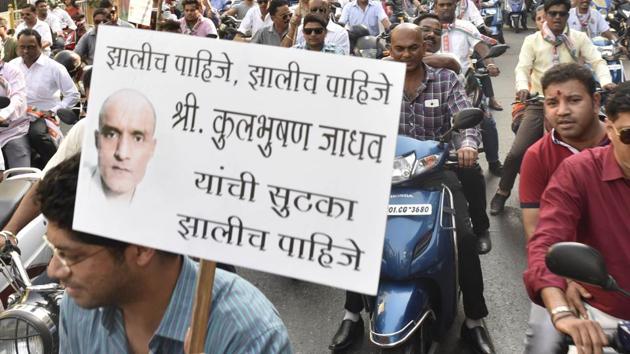
Jadhav was convicted by a Pakistan military court in April for espionage and subversive activities against the state
As the ICJ began hearing Jadhav’s case, India argued that human rights treated as “basics” all over the world had been thrown to the wind by Pakistan. New Delhi has called for immediate suspension of Jadhav’s death sentence and accused Pakistan of violating the Vienna Convention by denying its 16 requests for consular access.
Pakistan, in its submission in response to India’s presentation, said New Delhi was using the court as a “scene of political theatre” and the world court did not have the jurisdiction to provide the relief sought by its neighbour.
Both sides had 90 minutes each to argue their case.
{{/usCountry}}Both sides had 90 minutes each to argue their case.
{{/usCountry}}Here are the arguments made at The Hague:
India’s submission
• Jadhav was kidnapped from Iran in 2016, brought to Pakistan, presented as an alleged Indian spy and a confession was extracted in military custody.
• India made innumerable requests to Pakistan for consular access which were denied.
• Pakistan has not provided India any charge sheet, copy of the verdict and other documents.
• The trial was conducted without informing Jadhav.
• Graver the charges, greater the need for continued adherence to the Vienna Convention.
Pakistan’s submission
• “Wholly inappropriate” for India to seek provisional measures from this court.
• Pakistan invites ICJ to dismiss India’s application as there is no urgency in this plea and the court’s jurisdiction is limited. The Indian national has 150 days to seek clemency.
• India unwilling to explain the false passport, which bore a Muslim name and was found in Jadhav’s possession.
• Pakistan not violating Vienna Convention as Article 55 gives protection in matters of internal affairs and its provisions on consular access are not intended for a “spy” involved in terror activities.
• Delhi’s application to ICJ misconceived and unnecessary. The court is being used as political theatre but Pakistan won’t be cowed down by terrorism.
ABOUT THE AUTHOR
Follow the latest breaking news, major developments and agenda-setting stories from India and around the world with the newsdesk at Hindustan Times. Operating round the clock, the desk brings together experienced editors, reporters and correspondents to deliver fast, accurate and contextual reporting across subjects that influence public policy, governance, business, society and international affairs. The HT News Desk covers politics, elections, government policies, the economy, business and markets, science and technology, the environment, law and order, infrastructure, education, climate issues and geopolitics, while closely tracking developments across states, institutions and global capitals. The team also leads coverage of major breaking news events, policy announcements, court proceedings, natural disasters, public emergencies and significant international developments. Reports published by the newsdesk are based on information gathered from reporters on the ground, official statements, government agencies, court records, regulatory filings, recognised institutions and other authoritative sources. Stories undergo editorial scrutiny and verification processes to ensure accuracy, fairness and relevance, and are updated as events evolve and additional information becomes available. Whether covering a key political decision in New Delhi, an economic policy shift affecting millions, a landmark court ruling or a major global event, the HT News Desk aims to provide readers with reliable, fact-based journalism that delivers not only the latest developments but also the context and analysis needed to understand their wider implications.