
The government on Friday exempted more services from Covid-19 lockdown, in a fresh set of guidelines released by the Ministry of Home Affairs (MHA).
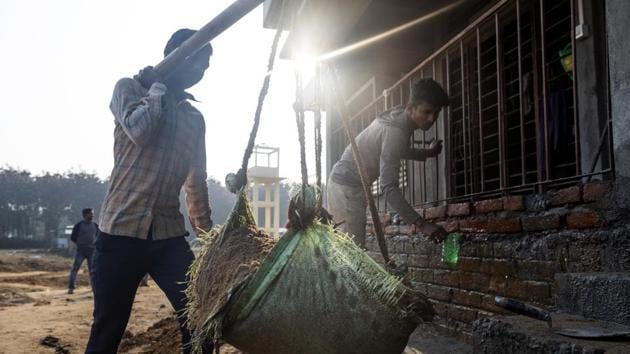
These exemptions include activities in farming/plantation, construction and banking sectors.
In plantation, collection, harvesting of minor forest produce, non-timber forest produce by Scheduled Tribes and forest dwellers; and harvesting, processing, packaging, sale and marketing of bamboo, coconut, arecanut, cocoa and spices plantation have been allowed.
Non-banking financial institutions, housing finance and micro finance institutions with minimum staff have been allowed to function during lockdown which has been extended till May 3.
Finally, construction activities in rural areas, water supply, sanitation, and laying of power, telecom lines have also been exempted from the lockdown by the MHA order.
The lockdown was extended after Prime Minister Narendra Modi said in hi address to the nation on April 14 - the last day pf phase 1 of lockdown - that stringent measures are needed to break the cycle of infection. He also urged people to follow social distancing norms, asked state governments to ensure lockdown is followed, announced some relaxation and warned that if rate of infection doesn’t stop, the government will be forced to withdraw these exemptions.
A detailed list of exemptions was released a day after the Prime Minister’s address in which the government conditionally allowed industries in rural areas and economic enclaves to reopen next week, green-lighted work under the federal job guarantee scheme, and permitted daily wagers in some areas to return to work.
{{/usCountry}}A detailed list of exemptions was released a day after the Prime Minister’s address in which the government conditionally allowed industries in rural areas and economic enclaves to reopen next week, green-lighted work under the federal job guarantee scheme, and permitted daily wagers in some areas to return to work.
{{/usCountry}}The guidelines were aimed at restarting the country’s economic engine and lessen the pain of millions affected by the ongoing lockdown to combat the spread of Covid-19.
The guidelines on the restart of the economy , with a sharp rural focus, was described as a giant first step by some analysts.
No public transport including planes, trains, buses, metro rail and taxis will be available during the second phase of the lockdown, which will last for 19 days, although courier services have now been allowed and will likely feed into air and rail cargo services, which were also operational during the first phase.
ABOUT THE AUTHOR
Follow the latest breaking news, major developments and agenda-setting stories from India and around the world with the newsdesk at Hindustan Times. Operating round the clock, the desk brings together experienced editors, reporters and correspondents to deliver fast, accurate and contextual reporting across subjects that influence public policy, governance, business, society and international affairs. The HT News Desk covers politics, elections, government policies, the economy, business and markets, science and technology, the environment, law and order, infrastructure, education, climate issues and geopolitics, while closely tracking developments across states, institutions and global capitals. The team also leads coverage of major breaking news events, policy announcements, court proceedings, natural disasters, public emergencies and significant international developments. Reports published by the newsdesk are based on information gathered from reporters on the ground, official statements, government agencies, court records, regulatory filings, recognised institutions and other authoritative sources. Stories undergo editorial scrutiny and verification processes to ensure accuracy, fairness and relevance, and are updated as events evolve and additional information becomes available. Whether covering a key political decision in New Delhi, an economic policy shift affecting millions, a landmark court ruling or a major global event, the HT News Desk aims to provide readers with reliable, fact-based journalism that delivers not only the latest developments but also the context and analysis needed to understand their wider implications.