E-Paper



CAQM report to SC: Long-term solutions recycled after years of pollution inaction
The Commission for Air Quality Management submitted its comprehensive long-term strategy to the Supreme Court on Wednesday.

 Prefer HTon Google


The Commission for Air Quality Management (CAQM) submitted its comprehensive long-term strategy to the Supreme Court on Wednesday, ostensibly to resolve the capital’s perennial air pollution crisis. However, a close reading suggests it is less a bold strategy and more a bureaucratic resurrection: The plan recycles recommendations from its predecessor, the Environment Pollution (Prevention and Control) Authority (EPCA), from eight years ago, dressing them up with newer technology labels while stripping away specific targets and deadlines.
The Supreme Court has now directed the Delhi government, municipal bodies and NCR state agencies to submit action plans within four weeks detailing how they will execute CAQM’s recommendations. The commission has been under fire for what experts have said is short-sighted and premature approach to Graded Response Action (Grap) restrictions — the mainstay of immediate pollution mitigation steps, which are often applied too late and lifted too quickly.
CAQM organises its “long-term solutions” under six broad measures with roughly 41 specific actions, while the EPCA detailed 37 in its 2018 Comprehensive Action Plan. A point-by-point analysis suggests at least two-thirds of the new suggestions tackle the same problems with similar solutions, while making no mention of why past plans failed or were never implemented.
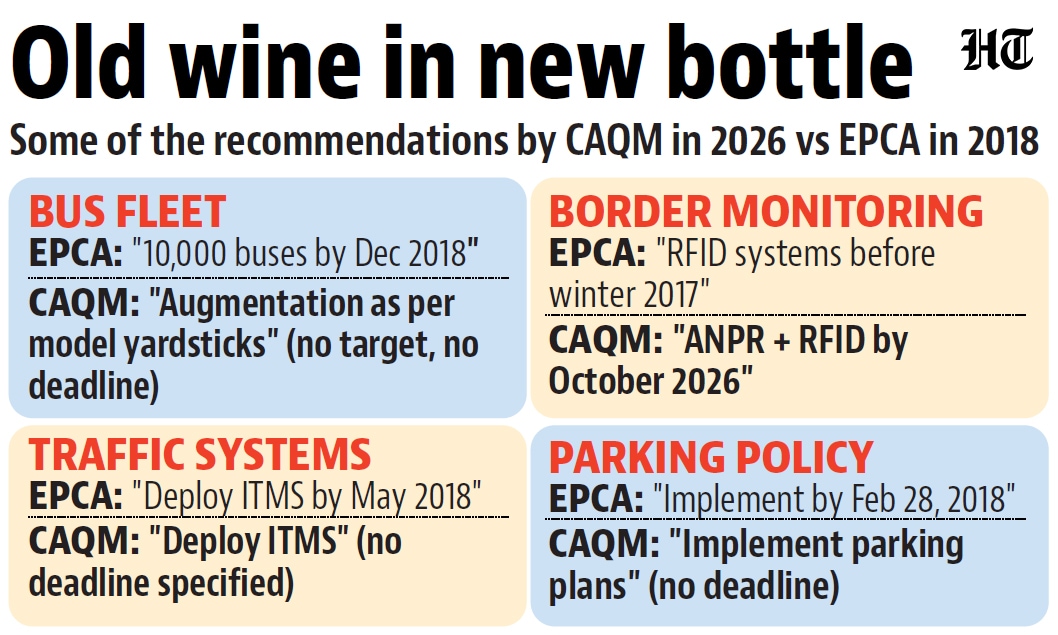
Consider the most basic measure: expanding Delhi’s bus fleet. The Supreme Court first ordered 10,000 buses in July 1998. The EPCA report stated the Delhi government “must ensure total compliance with order of 1998 and 2016 by December 2018”.
CAQM’s 2026 submission now recommends: “Augmentation of city public bus service through E-buses/CNG as per model yardsticks and service level benchmark of MoHUA based on population”—without a fleet target or timeline.
As per latest estimates, Delhi has fewer than 6,000 buses.
EPCA called for “implementation of multi-modal integration plan”; CAQM’s solutions propose “Development of Multi Modal Transport hub”. Eight years apart, both plans called for “integrated traffic systems”.
Similar repackaging appears in the vehicle tailpipe pollution monitoring system, the pollution under control (PUC) framework. EPCA called for “tighten PUC norms for post-2000 vehicles, upgrade in-use emissions testing”. CAQM recommends “strengthening of PUC 2.0 and monitoring of on-road vehicles with remote sensing devices”.
Experts concurred. “Many of these are simple replicas of old plans and there is little difference. The plan now needs a base emission inventory followed by emission reduction targets and caps along with mandatory timelines. A lot of action plan seems repetitive barring a few exceptions like no new coal plants in the 300 km region,” said Sunil Dahiya, founder and lead analyst at Envirocatalysts.
Where EPCA assigned dates—”May 2018”, “December 2018”, “mid-2018”—CAQM deploys elastic phrases: “in a phased manner”, “expeditious expansion”, “time-bound phasing out”.
“While long-term measures are great and give us a direction in which we should be moving, until there are tangible timelines and expectations set, we will never see results. This is because each measure has to be broken down into achievable milestones. We all know what has to be done but how it has to be done is what has to be planned out, so the gaps in implementation can be identified and solved one by one,” said Anumita Roychowdhury, executive director at the Centre for Science and Environment. Roychowdhury was closely associated with EPCA.
EPCA was disbanded after the CAQM was set up through legislation, with quasi-judicial powers.
Then there are strategies that appear to have made little difference. EPCA’s 2018 plan called for radio frequency-based identification (RFID) systems at Delhi’s 13 major border entry points to regulate truck traffic, a mechanism that has been in place since 2019. CAQM’s 2026 recommendation includes “installation of ANPR (automatic number plate recognition) cameras and automated RFID ensuring Multi Lane Free Flow (MLFF) enabled Toll/Cess collection at all Border Entry Points of Delhi” — admission that the entry surveillance through RFIDs did not help.
Some evolution does appear. CAQM’s emphasis on electric vehicles and charging infrastructure reflects policy progression from EPCA’s focus on BS-VI emission standards, though this also reflects the EV industry’s progress with vehicles becoming more affordable.
Similarly, CAQM proposes “technology-driven Integrated Command and Control Centres” for pollution monitoring—a centralised enforcement mechanism not detailed in EPCA’s plan. But centralised monitoring only matters if decentralised enforcement actually happens. The 2018 plan identified several of these problems; their reappearance in the new document amounts to admission that none has been solved.
The expert report accompanying CAQM’s submission provides evidence of stagnation. Based on a meta-analysis of studies from 2015 to 2025, transport contributes 23% (winter) and 19% (summer) to PM2.5 concentrations. Dust from roads, soil and construction accounts for 15% (winter) and 27% (summer). Biomass burning contributes 20% (winter).
These are the same sectors—transport, dust, biomass—that dominated EPCA’s 2018 action plan.
CAQM has now recommended strengthening waste collection to prevent open burning, complete processing of waste, integration of informal waste pickers and intensive IEC campaigns for citizens. These generic measures are already part of the Solid Waste Management Bye-Laws for Delhi notified on January 15, 2018.
Bharati Chaturvedi, founder and director of the waste management NGO Chintan Environmental Research and Action Group, said some of these measures have been on rule books for years but never implemented. “Recommendations and integration cannot be random. They need defined parameters and well defined plan with measurable outcomes. Contracts given to concessionaire need to be completely rewritten,” she added. “We need new contracts and start from scratch to tackle the waste and consequent air pollution crisis.”
CAQM’s status report notes it has issued “95 Directions and 17 Advisories, besides various orders, guidelines and official communications from time to time”. But directions and advisories are outputs, not outcomes. The number of directives issued says nothing about whether anyone followed them.
The commission acknowledges that “several policy interventions require adequate funding arrangements” and that implementation “primarily depends upon action plans formulated by the respective Government(s)/concerned agencies, along with the provision of requisite and adequate funding arrangements”.
CAQM’s submission arrived following sharp judicial criticism. On January 6, the Supreme Court observed that the commission was “failing in its duty” and showed a lack of “seriousness”, appearing to be “in no hurry to either identify the causes of the worsening AQI in Delhi-NCR or long-term solutions”. On December 17, the court described the pollution crisis as an “annual feature” and called for “pragmatic and practical solutions”.
The roadmap for implementation will now go to the same agencies that were meant to execute EPCA’s 2018 action plan—which contained many of the same recommendations with 2018 deadlines that are now being recommended again in 2026.
“The gap which has been showing up again and again when we talk about mitigation of air pollution sources, that is of implementation and governance. We already know what the major sources are as per the last emission inventory, but ever since CAQM has started functioning, there has been no proper prioritisation of sources,” said Mukesh Khare, an IIT Delhi professor and air pollution expert.
Bhavreen Kandhari, an environmental activist who is part of the group Warrior Moms, said measures listed by CAQM are not new, they largely recycle the 2018 EPCA recommendations that have remained on paper for years. “What Delhi now needs is a shift from advisory driven pollution control to outcome based strict governance; annual emission reduction targets, legally enforceable deadlines, transparent data on compliance. And this must include penalties for institutional non compliance and appropriate strict legal action in cases where corruption or deliberate interference compromises implementation. Without this, recycling old recommendations will only prolong the crisis rather than resolve it,” said Kandhari.