NEW DELHI: Maldivian President Mohamed Muizzu’s presence at the inauguration of Prime Minister Narendra Modi’s third term and his meetings with Indian leaders are being seen by observers as signs of a possible reset of bilateral relations that had dipped to a fresh low.
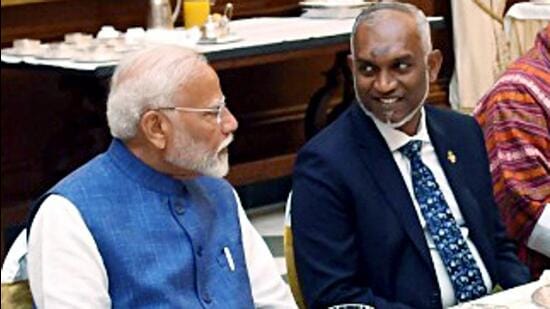
Muizzu, who has taken a range of steps to ramp up ties with China in areas ranging from defence to trade after winning last year’s presidential election on the back of an “India Out” campaign, was among leaders of seven countries from the neighbourhood and the Indian Ocean region invited to Modi’s swearing-in ceremony on Sunday. This was his first visit to India since becoming president last November.
His decision to accept the invitation to the ceremony was significant and reflects the Maldivian government’s desire to engage with the Indian side, people familiar with the matter said on condition of anonymity. The people also pointed to Modi’s brief meeting with Muizzu following the swearing-in ceremony and his meeting with Union minister S Jaishankar on Monday morning.
One of the people cited above said, “Like every sovereign country, the Maldives has every right to develop its relations with other countries. But they must be clear about where they want to take ties with India.”
{{/usCountry}}One of the people cited above said, “Like every sovereign country, the Maldives has every right to develop its relations with other countries. But they must be clear about where they want to take ties with India.”
{{/usCountry}}During a meeting with Maldivian foreign minister Moosa Zameer in New Delhi last month, Jaishankar had said “mutual interests and reciprocal sensitivity” should form the basis of ties between the two countries.
The people cited above said no structured bilateral meetings between Modi and the visiting leaders were planned because of the prime minister’s domestic travel plans.
Following the swearing-in ceremony on Sunday, Modi met the visiting leaders in a group at Rashtrapati Bhavan. He also held separate, brief one-on-one meetings with all of them, though the people said there were no substantive discussions at these interactions.
Images of the banquet hosted by President Droupadi Murmu at Rashtrapati Bhavan on Sunday night showed Muizzu seated next to Modi.
On Monday, Jaishankar met Muizzu, Bangladesh Prime Minister Sheikh Hasina, Sri Lankan President Ranil Wickremesinghe, Bhutan Prime Minister Tshering Tobgay, Mauritius Prime Minister Pravind Jugnauth, Nepal Prime Minister Pushpa Kamal Dahal and Seychelles vice president Ahmed Afif and discussed bilateral ties and ways to take forward cooperation in the region.
After the meeting with Muizzu, Jaishankar, who is set to return to the external affairs ministry, said in a post on X: “Delighted to call on President Dr Mohamed Muizzu of Maldives today in New Delhi. Look forward to India and Maldives working together closely.”
A readout from the Maldivian president’s office said the meeting focused on bilateral collaboration, and Musizzu and Jaishankar expressed their “eagerness to strengthen cooperation in areas of shared values and mutual interest”. They also reaffirmed their commitment to boost bilateral collaboration in the coming years.
Muizzu thanked Modi and the Indian government for assistance to the Maldives over the years, and said it was “an honour” to attend the swearing-in.
In a post after his meeting with Hasina, Jaishankar said the “India-Bangladesh Maitri [friendship] continues to advance”. A Bangladeshi official described the meeting as unstructured and said the two sides reviewed the overall relationship.
Following his meeting with Wickremesinghe, Jaishankar said on X: “Recognized the steady progress in India-Sri Lanka relations.”
While thanking the leaders for participating in the swearing-in ceremony, Modi reaffirmed India’s commitment to its “Neighbourhood First” policy and “SAGAR” vision or Security and Growth for All in the Region, according to a statement from the external affairs ministry.
Modi said in his third term, India will “continue to work for the peace, progress and prosperity of the region in close partnership with the countries, even as it pursues its goal of Viksit Bharat by 2047”. In this context, he sought deeper people-to-people ties and connectivity in the region.
India, he said, will “continue to amplify the voice of the Global South in the international arena”.