Traders rued their burnt shops, farmers mourned the death of their sons to police bullets; but as four days of violence drew to a close, both sides could only speak of one thing: demonetisation.
“Notebandi destroyed the trust between farmer and trader,” said Sunil Ghatiya, a soybean trader in Mandsaur’s Pipliya Mandi, “It finished off our market.”
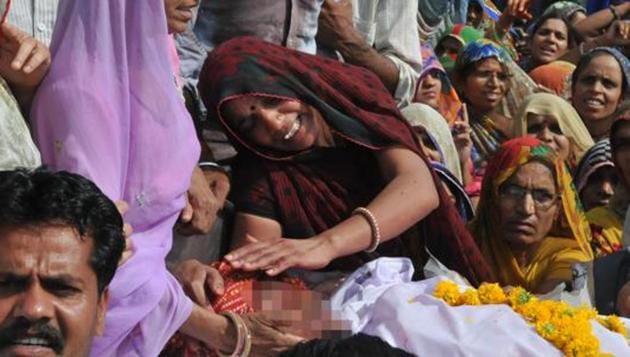
“The traders exploited us,” said Dinesh Patidar, whose son Abhishek was killed when police opened fire on farmers demanding loan waivers and better prices for their crops, “They knew the farmers were desperate for cash.” The Modi government insists the economy has weathered the shock of demonetisation of 86% of India’s currency on 8 November last year, even as evidence to the contrary piles up and economists say they lack the tools to isolate its effects.
In Mandsaur, where four days of rioting resulted in the deaths of five farmers and the destruction of crops, farms, shops, and trucks, the policy’s effects are visible: demonetisation has disrupted every aspect of the rural economy – land markets, credit networks, procurement, and crop prices. “A farmer sells when he needs cash immediately – for a wedding, a funeral, to pay a loan,” said Madan Lal Viswakarma, “But after notebandi, traders at the government-run markets only pay by cheque.”
{{/usCountry}}In Mandsaur, where four days of rioting resulted in the deaths of five farmers and the destruction of crops, farms, shops, and trucks, the policy’s effects are visible: demonetisation has disrupted every aspect of the rural economy – land markets, credit networks, procurement, and crop prices. “A farmer sells when he needs cash immediately – for a wedding, a funeral, to pay a loan,” said Madan Lal Viswakarma, “But after notebandi, traders at the government-run markets only pay by cheque.”
{{/usCountry}}The cheques take 20 days to clear, Madan Lal said, and then the banks have no currency to give. “If you want cash, the traders beat down your price, and charge two rupees on every hundred they pay,” he said.
The quest for cash, Lakshmi Narayan Viswakarma said, had pushed farmers deeper into debt.
“At harvest, everyone rushes to sell so they can pay back their loans,” he said, explaining that money lenders lend at 2% per month, or 24% a year, and settle all accounts in cash. Those who can’t pay, like farmer Dinesh Patidar, are forced to sell their land.
“But land prices have halved, from Rs 5 lakh per bigha, to Rs 2.5 lakh per bigha,” said Patidar. “After notebandi, no one has the cash to buy land,” he added.
Across the road from Patidar’s home, traders said the note-ban had destroyed them as well. “The farmers demanded cash, but the government tied our hands,” said Ghatiya, the soybean trader. “Some cheques bounced because of a spelling mistake, the farmers felt we were cheating them.”
Trader credit had dried up as well, reducing each trader’s purchasing power. “A lot of chit-fund money finds its way into the agricultural markets,” said a pulse trader, “That completely vanished this year, so traders couldn’t buy as much as they usually do.” As a result, unsold produce started piling up, and the price of all crops crashed.
“The price-crash has affected us as well,” said Ghatiya, “The value of the stocks in our godowns has fallen too.”
This spiral of currency shortage and falling prices, traders and farmers agreed, meant the market was on edge even before the protests began on June 1. So when farmers and traders got into an argument on June 5, the violence quickly escalated. “On one hand you had gun-powder, on the other a match,” said a senior cop, “All you needed was a spark.”