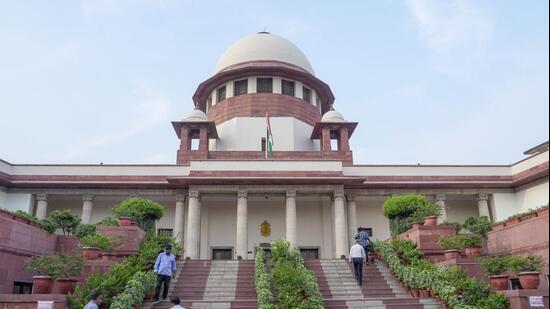
The Supreme Court on Wednesday told the Delhi Golf Club (DGC) to clearly disclose how it selects members within a week, expressing displeasure with the club submitting a “maze of documents” in response to its previous order.
“We made it clear that we need to know what are the modalities for providing membership to the club for all categories and the fee structure,” a bench of justices Ahsanuddin Amanullah and N Kotiswar Singh said.
“Do you want us to go through a maze of documents? Is this your understanding of this court’s order? If so, it is very unfortunate… We are not happy with the affidavit filed by the club. It had to give details of the procedure followed for grant of membership,” the court said, as it posted the matter for October 15.
Senior advocate Mukul Rohatgi appearing for the club said that he will file a short affidavit giving necessary details.
On August 24, the court asked DGC to bring on record the details with regard to what are the relevant rules, byelaws applicable and the modalities, procedures, practices adopted or followed, relating to grant of membership to the club for all categories.
The enquiry into membership rules emerged during hearings on a petition filed by Delhi resident Rajiv Suri regarding the upkeep of heritage structures.
{{/usCountry}}The enquiry into membership rules emerged during hearings on a petition filed by Delhi resident Rajiv Suri regarding the upkeep of heritage structures.
{{/usCountry}}In previous hearings, the court has pulled up the club for not maintaining the 10 heritage structures situated within and around the club inside the club boundary. These include an early Mughal tomb, Mir Taqi’s tomb, Tomb of Syed Abid, Gateway, Barah Khamba of Tughlaq era, among other similar ancient structures.
The court also appointed senior advocate Gopal Sankaranarayanan along with advocates Nipun Saxena and Vishal Sinha as court commissioners who inspected the site and found several facilities within the club to be in close proximity to these structures without the mandatory labels to preserve the sanctity of these monuments.
Interestingly, the Lal Bangla I and II (dating back to 1779-80 AD), situated near the club entry, are centrally protected structures under the management of the Archaeological Survey of India (ASI). Following the report of the court commissioners, the court on May 27 stopped any activity within the 100-metre prohibited zone around the two centrally protected structures. Further, public access was restricted around the remaining structures.
The club told the court that the restoration of the monuments had been handed over to the Aga Khan Trust. However, in July, while examining the restoration work carried out by the Aga Khan Trust, the bench took serious exception to the lime plaster over the structures that covered even the intricate designs that existed on the monument.
In February this year, the petitioner Suri submitted a 2021 report by INTACH documenting 1,100 notified heritage sites in Delhi based on which the court sought responses from the ASI, Delhi government, MCD and NDMC and sought remedial steps to restore their pristine glory. It was on Suri’s initiative, a Lodi-era monument in Defence Colony was restored and declared protected by the Delhi government’s Archaeology department.