
Slamming those opposed to setting up of transit accommodation for Kashmiri Pandits in the valley, Chief Minister Mehbooba Mufti on Monday questioned how the return of “our people” could bring about a demographic change.
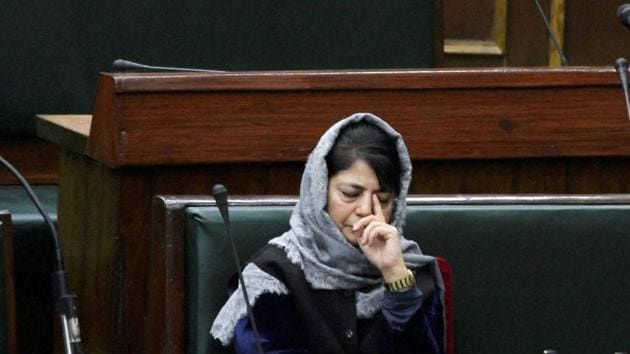
“They (separatists and others opposed) are saying that if the Kashmiri Pandits comes back it will be demographic change. How is it a demographic change?
“Those who have taught us, lived and grown up with us and in whose homes we used to eat food and those who are an inseparable part of our culture, what demographic change will there be if they return back to Kashmir? I fail to understand this logic,” Mehbooba said while winding up the discussion on Motion of Thanks to the Governor’s Address in Legislative Council here.
Though she did not name any party or group, Mehbooba was clearly referring to the separatists and some mainstream political parties which are opposing setting up of transit accommodation for Kashmiri pandits as part of their return to the Valley from which they were forced out in 1990.
“Our people want to come back and we say this is demographic change. They want to live in transit accommodation and we say that this is demographic change. This is absolutely wrong. It is not Kashmiriyat. And the true spirits of the real Kashmiriyat need to be revived again in the Valley.
{{/usCountry}}“Our people want to come back and we say this is demographic change. They want to live in transit accommodation and we say that this is demographic change. This is absolutely wrong. It is not Kashmiriyat. And the true spirits of the real Kashmiriyat need to be revived again in the Valley.
{{/usCountry}}“We need to work unitedly and together for this cause and without it there is no alternative,” Mehbooba said.
She said during the past 25-30 years, “we have suffered huge loss of lives and property in the turmoil. The composite culture has received a setback. The composite culture of the tolling of bells of temple (on Hari Parbat hills) and prayers at Makhdoom Sahib’s Ziarat and the ‘path’ (Sikh prayers) from the Gurudwara — I don’t know what has happened to this culture. An unpredictable atmosphere has been created.”
The Chief Minister said Jammu has become an example of Kashmiriyat as it has provided a home to all the people of Kashmir, including Kashmiri Pandits, Kashmir Muslims and Kashmiri Sikhs.
“I feel that Jammu has become Kashmir today (with regard to composite culture) and Kashmir has reached somewhere else. In Kashmir, Kashmiris do not have any sign of happiness on their faces, but when they reach Jammu, I feel they are alive. The people of Jammu have adopted the true culture of Kashmir (Kashmiriyat),” she said.
“But when the government talks about taking back Kashmiri Pandits to Valley and honourably rehabilitating them there, then an issue has been created,” she said.
“Forget about others even the mainstream people talk about demographic change. We should stop raking up the issue of demographic changes repeatedly. It is not Kashmiriyat,” the Chief Minister said.
She said such things may be happening in Afghanistan, Syria and in Iraq, where guns rule the roost “but this is not the culture of our Kashmir”.
ABOUT THE AUTHOR
Follow the latest breaking news, major developments and agenda-setting stories from India and around the world with the newsdesk at Hindustan Times. Operating round the clock, the desk brings together experienced editors, reporters and correspondents to deliver fast, accurate and contextual reporting across subjects that influence public policy, governance, business, society and international affairs. The HT News Desk covers politics, elections, government policies, the economy, business and markets, science and technology, the environment, law and order, infrastructure, education, climate issues and geopolitics, while closely tracking developments across states, institutions and global capitals. The team also leads coverage of major breaking news events, policy announcements, court proceedings, natural disasters, public emergencies and significant international developments. Reports published by the newsdesk are based on information gathered from reporters on the ground, official statements, government agencies, court records, regulatory filings, recognised institutions and other authoritative sources. Stories undergo editorial scrutiny and verification processes to ensure accuracy, fairness and relevance, and are updated as events evolve and additional information becomes available. Whether covering a key political decision in New Delhi, an economic policy shift affecting millions, a landmark court ruling or a major global event, the HT News Desk aims to provide readers with reliable, fact-based journalism that delivers not only the latest developments but also the context and analysis needed to understand their wider implications.