The Union women and child development (WCD) ministry has found in a survey conducted in November last year that nearly half of the samples of midday meals that it tested from across 11 states and Union Territories (UTs) did not follow proper nutrition norms, according to officials familiar with the matter.
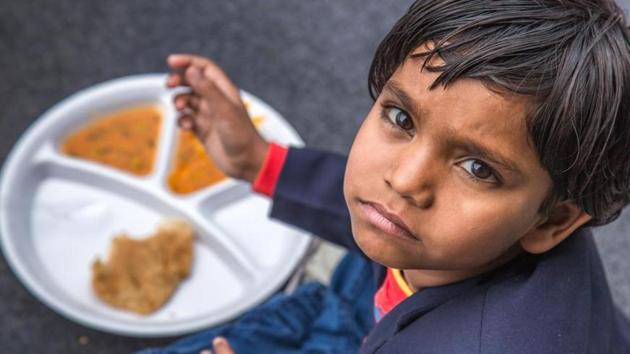
The 162 samples were taken from areas that cater to about 28 million children. In the report, accessed by HT, 79 of these were found to be below the standards prescribed by the Centre under the Supplementary Nutrition Programme (SNP).
SNP norms cater to three categories of children — between the ages of 6 months and 3 years, between 3 and 6 years of age, and children receiving pre-school education. Midday meals and free take-home rations are the two kinds of food provided.
The survey, one of the WCD ministry officials cited above said, was prompted by the an incident in September last year in Uttar Pradesh’s Mirzapur district, where a video of children being served rice and salt as their midday meal went viral on social media.
According to SNP norms, take-home ration for children between ages of six months to three years and morning snacks and cooked meals for children between three and six years of age should have at least 500 kilocalories (kcal) and 12-15 grams of protein. The norms stipulate that malnourished children between 6 months and 6 years of age should be given food with 800 kcals and 20-25 grams of protein.
{{/usCountry}}According to SNP norms, take-home ration for children between ages of six months to three years and morning snacks and cooked meals for children between three and six years of age should have at least 500 kilocalories (kcal) and 12-15 grams of protein. The norms stipulate that malnourished children between 6 months and 6 years of age should be given food with 800 kcals and 20-25 grams of protein.
{{/usCountry}}States need to spend a minimum of Rs 8 per meal for children between the age of six months and six years, and Rs 12 for malnourished children in the same age group.
On November 14, celebrated in India as Children’s Day, the WCD ministry discussed these findings as well as assessments of other schemes with representatives from various states in a day-long meeting at Delhi’s Vigyan Bhawan.
The ministry examined samples from Delhi, Karnataka, West Bengal, Bihar, Assam, Punjab, Chhattisgarh, Chandigarh, Arunachal Pradesh, Andaman and Nicobar Islands, and Meghalaya. Samples were tested by a team from the Centre. Most of them fell foul of the required kilocalories and protein content.
Among a host of directives, which include instructions to have proper infrastructure, the Centre has now asked these states to fix the discrepancies. Status reports will be taken up in a review meeting, planned for around March this year.
Economist and social scientist reetika Khera, an Associate Professor of Economics and Public Systems at Indian Institute of Management Ahmedabad said that while 162 samples might not be indicative of the lakhs of anganwadi centres, it points at a problem.
“It is worth reiterating that the first 1000 days of a child sets their nutrition map for their whole life. The government should systematise auditioning of samples, for greater scrutiny. The budgetary allowance can be enhanced; and states should include eggs as an option for those who eat them,” said Khera