Senior military commanders of the Indian and Chinese armies on Saturday met in eastern Ladakh to discuss the roadmap for further disengagement of their troops at friction points on the contested Line of Actual Control (LAC), with the talks taking place after the completion of the first round of disengagement in the Pangong Tso sector, people tracking the developments said on the condition of anonymity.
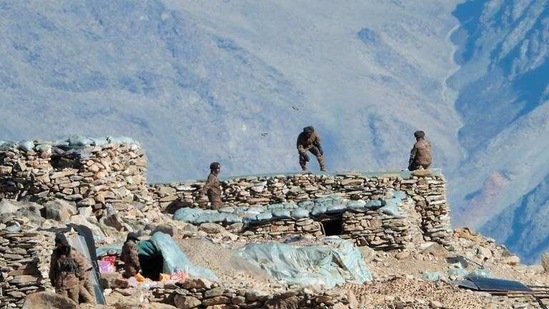
The corps commander-ranked officers met at Moldo on the Chinese side of the LAC for the 10th round of military dialogue to ease tensions in the Ladakh sector. The talks began at 10 am and were in progress when this report was filed.
Outstanding problems with the People’s Liberation Army (PLA) at Depsang, Hot Springs and Gogra - friction points on the contested border - were on the agenda, said one of the persons cited above.
“The proposals discussed during the talks to normalise the border situation will be put up by both sides before their higher authorities. The agreement on the next steps of disengagement will be finalised after that. We expect disengagement at the remaining friction points to proceed smoothly as it did in the main trouble area (Pangong Tso heights),” said a second person.
Also read: Over 5,000 Covid-19 variants in India - Here are more transmissible ones
{{/usCountry}}Also read: Over 5,000 Covid-19 variants in India - Here are more transmissible ones
{{/usCountry}}The India-China border standoff began last May and saw both sides deploy 50,000 troops each in the Ladakh theatre along with advanced weaponry.
The PLA’s deployments in Depsang have hindered access of Indian soldiers to Patrolling Points (PP) 10, 11, 11-A, 12 and 13, as previously reported by Hindustan Times.
The Indian Army’s patrolling activity has also been affected in Hot Springs and Gogra, where rival troops are forward deployed and where skeletal disengagement took place last year, but the gains could not be consolidated.
The Pangong disengagement took place on strategic heights on both banks of the lake. It saw the two armies pull back their frontline troops, tanks, infantry combat vehicles (ICVs) and artillery guns under an agreement reached earlier this month. The disengagement began on February 10.
“I think we should not expect very speedy results (in other areas). Depsang, in particular, is one area where discussions to arrive at a consensus could be protracted,” former Northern Army commander Lieutenant General DS Hooda said on the eve of the military talks.
The disengagement will be phased, coordinated and verified at all friction points. The first round of disengagement at Pangong Tso involved the pulling back of troops deployed eyeball-to-eyeball on the Finger 4 ridgeline at heights of almost 18,000 feet as well as withdrawing soldiers holding positions on the Kailash range on the south bank.
On the north bank, the PLA has retreated to its base east of Finger 8, while the Indian Army has moved back to its permanent position near Finger 3. Under the disengagement agreement, neither side will patrol the contested areas in between Fingers 4 and 8 until an agreement is reached through future talks.
The Indian claim line extends to Finger 8, while the Chinese claim is up to Finger 4.
India’s bold moves on the south bank of Pangong Tso last August boosted the army’s bargaining power during military talks and eventually led to an agreement on disengagement. The Indian Army occupied a series of key heights to prevent the PLA from grabbing Indian territory on the south bank in a stealthy midnight move on August 29, 2020.
The Indian Army followed this up by rushing its front-line tanks and ICVs to strategic heights held by its soldiers.
Northern Army commander Lieutenant General YK Joshi told media last week that India and China were on the brink of war after the actions on the south bank.