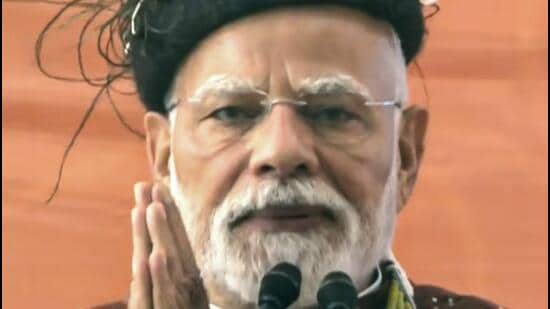
Prime Minister Narendra Modi on Monday laid foundation stones for projects worth over ₹5,100 crore in Arunachal Pradesh, including two hydropower plants in Shi Yomi district, bordering China, calling them “double benefits of double engine” Bharatiya Janata Party (BJP)-led governments at the Centre and in the state.
The over ₹3,700 crore power projects, Heo (240 MW) and Tato-I (186 MW), on the Siyom sub-basin, seek to harness the hydroelectric potential of Arunachal Pradesh and promote sustainable energy generation, bringing socio-economic benefits to the region.
The two projects were launched even as a section of locals have been protesting against the Siang Upper Multipurpose Project (SUMP) due to environmental concerns. In May, hundreds of people took to the streets in three districts against the deployment of central paramilitary forces for surveys for the hydropower project on the Siang River. The government has maintained that the SUMP would counter the potential risks of a mega Chinese hydropower project across the border on the same river.
In December, China approved the construction of what will be the world’s biggest hydropower dam on the eastern rim of the ecologically fragile Tibetan plateau. The approval triggered concerns about the impact of the dam, which could affect millions downstream in India and Bangladesh.
Modi, who laid foundation stones and inaugurated projects worth ₹35,000 crore in Mizoram, Manipur, and Assam this month, blamed the previous Congress government for neglecting the northeast despite its immense potential. He called his Arunachal visit special for three reasons. “I got to see such beautiful mountains on the first day of Navratri...Secondly, the next generation GST reforms have come into force from today [Monday], and development projects [for which foundation stones were laid].”
{{/usCountry}}Modi, who laid foundation stones and inaugurated projects worth ₹35,000 crore in Mizoram, Manipur, and Assam this month, blamed the previous Congress government for neglecting the northeast despite its immense potential. He called his Arunachal visit special for three reasons. “I got to see such beautiful mountains on the first day of Navratri...Secondly, the next generation GST reforms have come into force from today [Monday], and development projects [for which foundation stones were laid].”
{{/usCountry}}He said when he took charge in 2014, he decided to do away with the attitude of Congress and focus on the development of the northeast. “We have increased budget allocation for the region manifold...Since the BJP came to power at the Centre, Union ministers have visited the northeast over 800 times, and I have come here over 70 times,” he said.
Modi referred to the programme for the development of backward districts and work undertaken in around 450 villages in Arunachal near the border with China, including new roads, electricity, and internet. He reiterated that India will become developed only when it becomes self-reliant. “For that to happen, we have to stress on swadeshi. It is the call of the times that we buy or sell only things made in India,” Modi said.
Modi, who also laid the foundation stone of a Convention Centre at Tawang and infrastructure projects worth over ₹1,290 crore, interacted with traders in Itanagar as part of “Bachat Utsav (savings festival)” with the implementation of GST rationalisation.
Modi was due to inaugurate the development work at Mata Tripura Sundari Temple Complex in Tripura’s Matabari under the Pilgrimage Rejuvenation And Spiritual Heritage Augmentation Drive. The work involves new pathways, renovated entrances and fencing, a drainage system, a new three-storeyed complex consisting of stalls, meditation hall, guest accommodations, office rooms, etc.