E-Paper



More work needed to undo Congress’s anti-farmer policies: PM Modi
Prime Minister Narendra Modi was addressing a public meeting after laying the foundation stone of an ammonia-urea fertiliser plant at Namrup in Assam’s Dibrugarh district


Guwahati: Prime Minister Narendra Modi on Sunday accused previous Congress governments at the Centre of neglecting farmers’ needs for decades and said that while his government has pursued farmer-friendly policies over the past 11 years, more work is needed to address all outstanding issues.
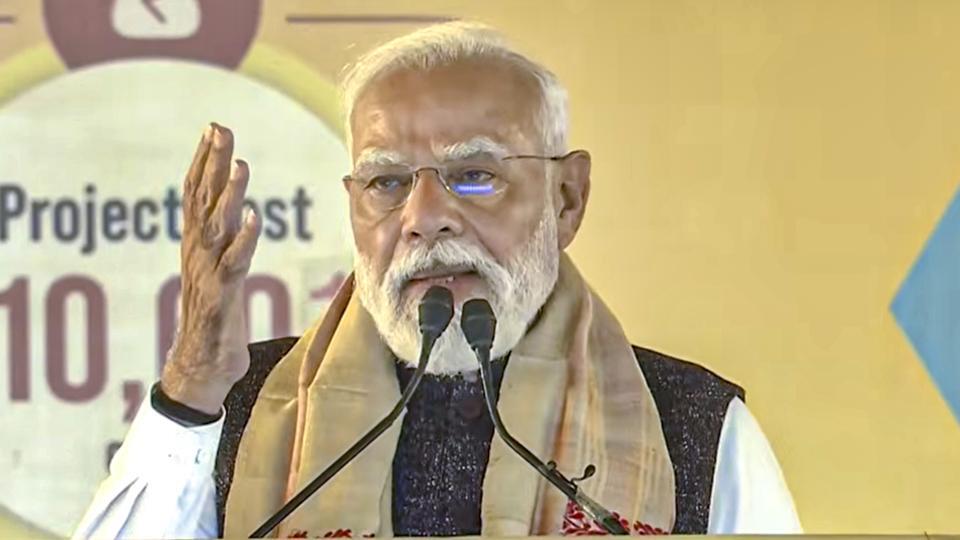
Addressing a public meeting after laying the foundation stone of an ammonia-urea fertiliser plant at Namrup in Assam’s Dibrugarh district, PM Modi said, “Farmers have a big role in the goal of establishing a Viksit Bharat (Developed India) and therefore our government is working day and night keeping their benefits in mind. In addition to agricultural incentives, it is necessary to ensure enough urea fertiliser for our farmers. This new plant will help achieve that.”
Modi accused previous Congress governments at the Centre of failing to upgrade the existing fertiliser plant at Namrup with improved technology, which led to the closure of some units in the complex, in turn affecting urea production and farmers’ agricultural output.

“Congress didn’t try to find a solution to this issue. Now our double-engine governments (at the Centre and in Assam) are solving these problems created by Congress. Earlier, farmers had to queue up for fertilisers as many other plants across the country also shut down, and police used to baton-charge them (farmers),” he said.
“Despite our hard work in the past 11 years to correct these issues (by reviving several fertiliser plants), there’s still a long way to go to resolve all the bad things (that Congress governments did),” he added.
PM Modi said India is on the way to becoming self-reliant in fertilisers in the near future. In 2014, only 22.5 million metric tonnes of urea were produced annually in the country. Over the past 11 years, this has increased to 30.6 million metric tonnes a year.
“There’s still more work to do. The country needs 38 million metric tonnes of urea annually. Hopefully, we will be able to fill this gap soon,” he said.
Modi added that the Centre heavily subsidises urea imported from abroad so that the cost burden does not fall on farmers. He urged farmers to reduce the use of urea in their fields to ensure soil quality does not suffer, and highlighted schemes such as the Kisan Credit Card launched by the Centre since 2014.
He also accused the Congress of encouraging illegal infiltration and providing protection by opposing the special intensive revision (SIR) of electoral rolls.
“They are only hungry for power. That’s why they like illegal infiltrators from Bangladesh.... we have to protect Assam from this poison of appeasement. Our party, BJP, is strongly protecting your interests and of Assam,” he said.
The new fertiliser plant at Namrup will be part of the newly formed joint venture company, Assam Valley Fertiliser and Chemical Company Limited (AVFCCL). The plant will have an annual capacity of 1.27 million metric tonnes.
To be set up at an estimated cost of ₹10,601 crore, commissioning of the plant is expected within the next 48 months. It is expected to boost domestic urea production, particularly in the northeast region.
Once production begins, it will meet the growing demand for urea fertilisers in the northeast, Bihar, West Bengal, eastern Uttar Pradesh and Jharkhand. The new plant will be energy-efficient and is expected to generate direct and indirect employment in the region.
The PM in his speech also mentioned about Mission Palm Oil with special focus on states in northeast. “This mission will not only make India self-sufficient in edible oil but will also increase income of farmers of the northeast region,” he said.

Earlier in the day, Modi, who spent Saturday night in Guwahati, interacted with a group of 25 students from across Assam in a special edition of Pariksha Pe Charcha aboard the Charaidew barge while cruising on the Brahmaputra in Guwahati.
He later visited the newly opened Swahid Smarak Kshetra, built as a memorial to the 860 people who lost their lives during the 1979–85 Assam Agitation against illegal infiltrators, and paid his respects before leaving by a special aircraft for Dibrugarh airport. From there, he reached the venue of the public meeting at Namrup by helicopter.
The Prime Minister is scheduled to leave for Delhi from Dibrugarh airport later in the day.