The second edition of the National Tribal Literary Festival 2026 began on Thursday in Delhi, bringing together tribal writers, poets, researchers and language experts from across the country to deliberate on preserving indigenous languages, oral traditions and literary heritage.
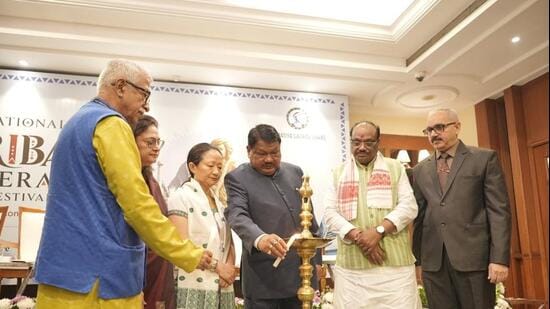
Organised by the Union ministry of tribal affairs at the India Habitat Centre as part of the Janjatiya Gaurav Diwas Pakhwada, the two-day festival is themed “From Oral Tradition to Contemporary Tribal Literature”.
Also Read: National Tribal Literary Festival begins in Delhi
Inaugurating the festival, Union tribal affairs minister Jual Oram stressed the need for systematic documentation of tribal literature, folk songs, folktales and oral traditions, saying the effort must involve not only writers but also lyricists, musicians, folk artists and digital content creators.
“Preserving tribal languages and oral traditions is central to building Viksit Bharat 2047,” the minister said.
Pointing out that several tribal languages do not have a written script and some dialects are on the verge of extinction, Oram said the absence of a script should not become an obstacle to their preservation. Oral traditions could be documented through other Indian languages, he said, adding that the ministry would collaborate with the Sahitya Akademi and other organisations to promote tribal literature.
Minister of state for tribal affairs Durgadas Uikey said the declaration of November 15, the birth anniversary of Bhagwan Birsa Munda, as Janjatiya Gaurav Diwas was an initiative to bring tribal heroes, freedom fighters and their contributions into the national consciousness. He also presented a ten-point framework covering folktales, songs, heroic sagas, myths, proverbs, riddles, rituals and prayers.
{{/usCountry}}Minister of state for tribal affairs Durgadas Uikey said the declaration of November 15, the birth anniversary of Bhagwan Birsa Munda, as Janjatiya Gaurav Diwas was an initiative to bring tribal heroes, freedom fighters and their contributions into the national consciousness. He also presented a ten-point framework covering folktales, songs, heroic sagas, myths, proverbs, riddles, rituals and prayers.
{{/usCountry}}Tribal affairs secretary Ranjana Chopra said the festival provided a platform for emerging writers to interact with established authors and publishers. Emphasising that oral traditions must be documented before they disappear, she said the event would become an annual feature during the Janjatiya Gaurav Diwas Pakhwada.
The first session, titled “Tribal Literature: From Community Memory to Contemporary Expression”, examined the relationship between traditional knowledge and modern literary expression.
K Vasamalli, representing the Toda community of the Nilgiris, spoke about efforts to preserve the endangered Toda language, which has around 2,000 speakers. Her initiatives include radio recordings and a 5,700-word dictionary. She said language was fundamental to preserving a community’s culture and traditions.
Also Read:CM Modi to PM Modi: A tale of continuity and evolution
Participants also highlighted the need to preserve tribal values amid modernisation. Prof Anil Kumar Boro cited the example of the Mizo community, saying traditional discipline and social values could coexist with urban lifestyles.
A subsequent poets’ meet featured readings in different tribal languages, while a session on folklore explored songs, myths, riddles and oral narratives.
Researcher Lisa Lomdak emphasised that sacred tribal knowledge should be documented and published only with the explicit consent of communities. She also highlighted women’s role in preserving oral traditions through songs and stories passed across generations.
The discussions concluded with suggestions to link state tribal affairs portals with the ministry’s website, digitise archival material held by international institutions and scientifically document indigenous knowledge, including Meghalaya’s living root bridges.
The second day will feature discussions on oral epics, heroic traditions and the role of oral knowledge in multilingual education, besides story and poetry readings in tribal languages.