Prime Minister Narendra Modi will commission INS Vikrant aircraft carrier into the Indian Navy on September 2 afternoon. With the commissioning, India will showcase its capability and material technology to design and build aircraft carriers after indigenously building three nuclear-powered ballistic missile submarines. After September 2, the Indian Navy will be a two-carrier Navy albeit Vikrant will take another year to become fully operational and INS Vikramaditya will be fully functional by year-end.
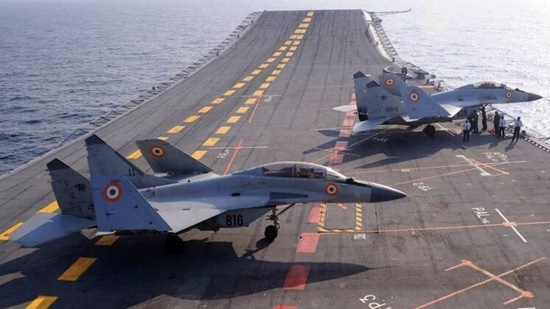
While the debate has already started on India having a third aircraft carrier with a bigger capacity, capability, and operational radius, there is a need for the Indian Navy to prove its worth with the existing robust force before acquiring any bigger boy toys. With two aircraft carriers and half a century of experience in naval aviation, the Indian Navy today is a force to reckon with in the Indo-Pacific with the capacity to open the seafront against any Asian power. The Indian Navy must move from a maritime diplomacy mindset and be prepared to take on the adversary on the high seas. It needs to move away from simply force projection to force application. Simply put, the Indian Navy needs to show teeth as the theatre has shifted from mere blockading of Karachi harbour to the Indo-Pacific and against an adversary who wants to be the number one power in the world and is willing to throw all rule books out of the window in pursuit of its ambition. The brazen and uncouth statement of the Chinese Ambassador to Sri Lanka, describing India as having occupied the Island nation 17 times in history is just hors d’oeuvre. The Chinese war dance around Taiwan and the Indo-Pacific cannot merely be dismissed as Kabuki for domestic audiences. Just like May 2020 in Ladakh, China is applying force and announcing its presence as a pre-eminent power on the global stage.
The Indian Navy’s desire to have a third aircraft carrier only makes sense if it can take on an adversary at its doorstep and deep in the Indo-Pacific. There is no point in spending billions of dollars on having a carrier strike force to protect the Bay of Bengal or the Arabian Sea. This can be easily ensured from airbases on India’s island territories and anti-ship ballistic missiles. One must remember that France with its overseas territories has just one aircraft carrier strike force and the UK, once a pre-eminent naval power with overseas territories, has two aircraft carriers. Neither Japan nor Germany has aircraft carriers with China the new kid on the block as far as naval aviation is concerned. The only big player in this game is the US, which happens to have strategic convergence with India in the Indo-Pacific as they face a common threat, China.
{{/usCountry}}The Indian Navy’s desire to have a third aircraft carrier only makes sense if it can take on an adversary at its doorstep and deep in the Indo-Pacific. There is no point in spending billions of dollars on having a carrier strike force to protect the Bay of Bengal or the Arabian Sea. This can be easily ensured from airbases on India’s island territories and anti-ship ballistic missiles. One must remember that France with its overseas territories has just one aircraft carrier strike force and the UK, once a pre-eminent naval power with overseas territories, has two aircraft carriers. Neither Japan nor Germany has aircraft carriers with China the new kid on the block as far as naval aviation is concerned. The only big player in this game is the US, which happens to have strategic convergence with India in the Indo-Pacific as they face a common threat, China.
{{/usCountry}}The Chinese activity in the Indian Ocean region has steadily increased over the past decade with no less than 53 Satellite and Ballistic Missile tracking vessels, also euphemistically called Research Vessels, monitored by the Indian Navy units since 2020. While Beijing is trying to make the South China Sea its backyard, it is sending more warships to the Indian Ocean and far Pacific in the name of maritime diplomacy or anti-piracy operations. It is only a matter of time before the Chinese carrier strike force will be transiting through the Indian Ocean and putting pressure on the Indian Navy and the sea lanes emanating from the Persian Gulf. India’s adversary is well defined and there is no illusion about this within the national security planners. A third aircraft carrier only makes ample sense if the Indian Navy is ready to shed its spotless white uniform and shining white shoes for battle fatigues.