Principal secretary to the Prime Minister PK Mishra on Wednesday urged closer integration of scientific research, reliable data and policymaking to tackle challenges in agriculture, food security and nutrition posed by climate change.
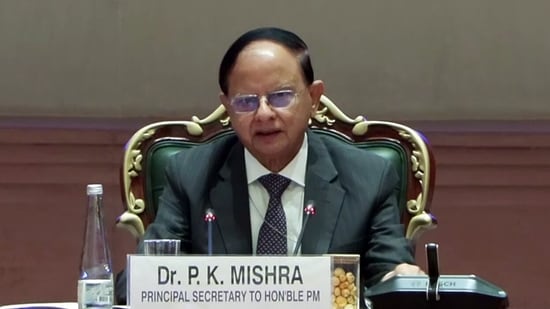
Addressing the inaugural session of the 20th Annual Meeting of the Environment for Development (EfD) Network at the Indian Institute of Management (IIM), Kozhikode, Mishra said India needs to strengthen the availability and use of district-level data to anticipate climate risks and make agricultural and food security policies more responsive to local conditions.
“National and state-level averages are important, but they do not always reveal the differences that matter on the ground,” he said, adding that data must be sufficiently detailed to capture local variations.
“Simply more data is not enough. We must generate information that is timely, reliable, comparable and useful for decision making,” he added.
He pushed for combining administrative records, household surveys, satellite imagery and geospatial data to produce more granular, district-level insights that reflect local variations in climate conditions.
Mishra said assessments by the Indian Council of Agricultural Research’s (ICAR) under its National Innovations in Climate Resilient Agriculture programme found that 310 of the country’s 651 agricultural districts were highly or very highly vulnerable to climate change.
{{/usCountry}}Mishra said assessments by the Indian Council of Agricultural Research’s (ICAR) under its National Innovations in Climate Resilient Agriculture programme found that 310 of the country’s 651 agricultural districts were highly or very highly vulnerable to climate change.
{{/usCountry}}He said climate change was directly linked to economic development, agricultural productivity, water availability, food security, public health and livelihoods. “People must also have access to affordable, diverse and nutritious diets,” he said, noting that climate-related changes could affect the availability and affordability of pulses, fruits, vegetables and milk.
Speaking on global cooperation, Mishra said countries in the Global South faced common challenges, including climate variability, pressure on natural resources and the need to ensure food security and better nutrition.
“These challenges are not confined to any one country,” he said, and urged sharing of data, research, policy experiences and successful approaches to develop solutions suited to local conditions.
He also said India’s goals of becoming a developed nation by 2047 and achieving net-zero emissions by 2070 had to be balanced with economic growth, poverty reduction and improvements in living standards.
The EfD Network is a global group of environmental economics research centres that seeks to link research with policymaking on environmental and development challenges.
(With inputs from ANI)