
 E-Paper



NEET-UG 2024 paper leaked in Jharkhand; NTA officials had no role: CBI
According to officials, the CBI is expected to form a special team to investigate the leak reported from Rajasthan

 Prefer HTon Google


As the Centre on Tuesday cancelled the National Eligibility-cum Entrance Test (NEET-UG) exam held on May 3 and ordered a Central Bureau of Investigation (CBI) probe, the federal agency’s investigation into the identical 2024 leak concluded that the paper was leaked at the local level in Jharkhand and that National Testing Agency (NTA) officials had no role in it.
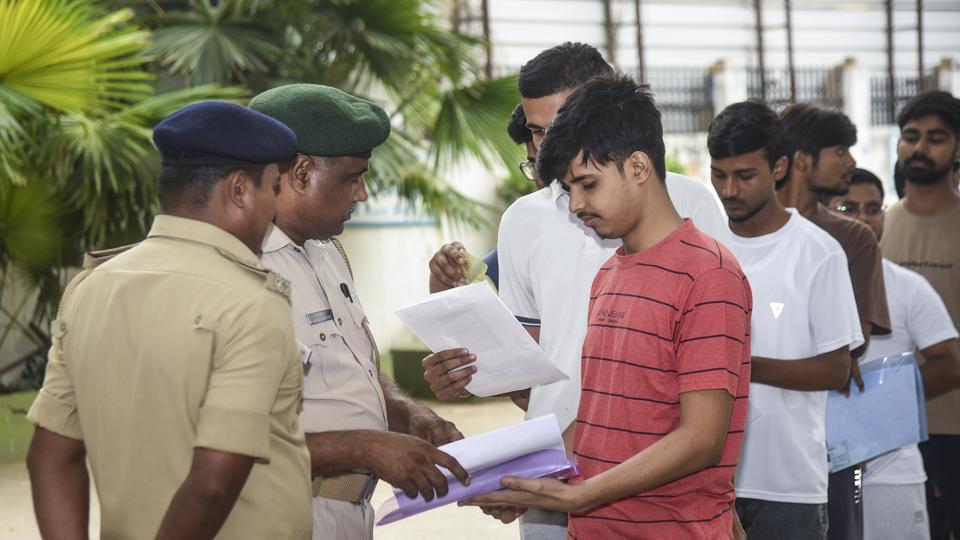
In its 2024 probe, the federal agency arrested around 50 people, including members of a Bihar-based gang and its two key individuals-- Baldev Kumar and Aman Singh, staff of a Hazaribagh-based school, solvers and facilitators, and filed five charge sheets.
A key suspect arrested by the Bihar police in the leak-- Sanjeev Mukhia-- was never charged by the CBI as it found no evidence against him.
The agency shared the names of around 153 beneficiaries and medical students who acted as “solvers”-- for which they charged in lakhs-- with the NTA for taking action against them. Beyond that, it found no systemic problems in the conduct of the exam.
“The 2024 NEET (UG) leak probe was over in 2024-2025 itself. The cases have been charge-sheeted, and the trial is on,” said an officer on condition of anonymity.
Following the NEET-UG 2024 paper-leak row, the government, acting on the K Radhakrishnan committee’s recommendations, created 16 new posts in NTA, with three Joint Directors joining so far, while Abhishek Singh took over as Director General in April 2026. District-level coordination committees headed by District Collectors were set up, and 94% of exam centres were shifted to state government or government-owned buildings.
For NEET-UG 2026, NTA mobilised over 200,000 personnel, including 674 city coordinators, over 6,000 observers, centre superintendents and invigilators, with active support from district administrations and police.
It remains to be seen if the recent leak reported in Rajasthan is the work of a smaller local gang or an organised network involving government officers.
Also Read:NEET 2026 exam held on May 3 cancelled over ‘paper leak’, new date to be notified
According to officials, the CBI is expected to form a special team to investigate the leak reported from Rajasthan. The state special operations group (SOG) and questioned 15 people including owners of coaching centres, consultants and solvers.
The NTA in a post on X on Sunday said were transported in GPS-tracked vehicles carrying unique, traceable watermark identifiers, while examination centres were monitored through AI-assisted CCTV surveillance from a central control room.
“The National Testing Agency is aware of reports concerning the action initiated by the Rajasthan Special Operations Group in connection with alleged irregularities around NEET (UG) 2026. The examination on May 3, 2026 was conducted as scheduled and under a full security protocol,” the NTA said.
It added that inputs regarding alleged malpractice activity were received on the evening of May 7, four days after the examination, and were escalated to central agencies on the morning of May 8 for “independent verification and necssary action.”


