
 E-Paper



NEET-UG 2026 cancelled after ‘leak’: 120 questions from guess paper, 600 of 720 marks | Explained
NTA said it got inputs regarding “malpractice” on May 7, and escalated the matter to central agencies on May 8 for independent verification.

 Prefer HTon Google


India's largest undergraduate medical entrance examination — NEET UG 2026 — has been cancelled on Tuesday, just over week after being conducted on May 3, as it landed at the centre of a controversy over alleged irregularities. This came less than two years after the NEET UG 2024 scandal that triggered nationwide protests, Supreme Court hearings, and a CBI investigation.
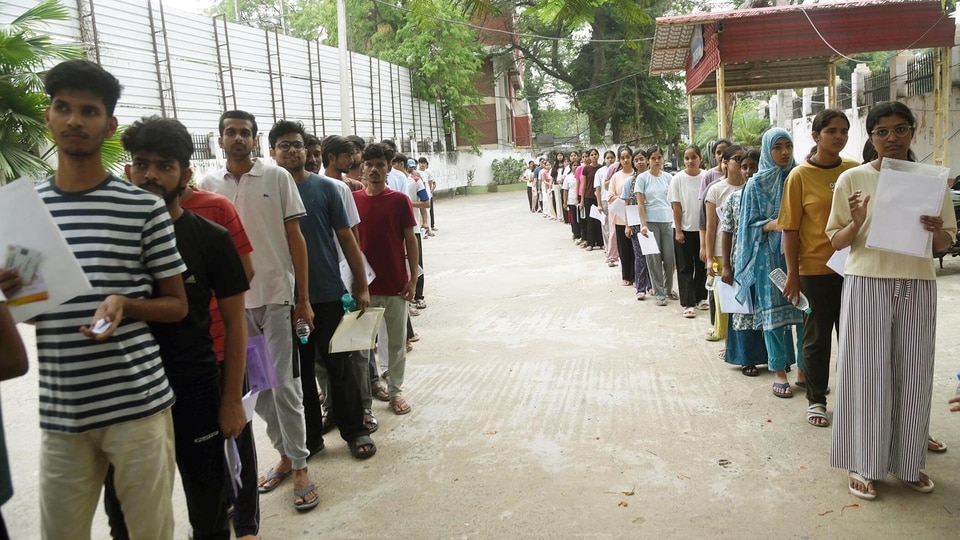
With around 1 lakh MBBS seats available against over 22 lakh applicants, a difference of a few marks determines whether a student secures a government college seat, pays crores at a private college, or gets no seat at all.
Here is everything you need to know.
How NEET-UG 2026 was conducted
The National Eligibility-cum-Entrance Test (Undergraduate), or NEET UG, is the single gateway to admission into MBBS, BDS, BAMS, BHMS, BUMS, and other undergraduate medical programmes across India. Every student who wishes to study medicine in India — whether at AIIMS, a government medical college, or a private institution — must clear this exam.
This year, 22.79 lakh students appeared for it. The exam was held on May 3, 2026, from 2 to 5 pm, in pen-and-paper mode, across 551 cities in India and 14 cities abroad, covering more than 5,400 centres.

What's the ‘leak’?
The Rajasthan Police's Special Operations Group (SOG) began investigating reports that a handwritten document, described as a "guess paper", containing exam questions had been circulating among students before the examination.
The Central Bureau of Investigation (CBI) has now taken over the probe as the exam stands cancelled.
The SOG confirmed it is examining a document containing approximately 410 questions. SOG Additional Director General Vishal Bansal stated that over 100 questions from the Biology and Chemistry sections combined showed "striking similarities" to the actual exam paper, with roughly 120 alleged matches across those two subjects. Separately, sources linked to the probe told media outlets that the similarities could account for nearly 600 of the 720 total marks.
Bansal said the document had reportedly been circulating among students "as early as 15 days to a month" before the exam. A report in news agency PTI, citing police sources, said the circulation could have started 42 hours before the exam via WhatsApp.
How ‘guess paper’ spread via WhatsApp
The probe so far said the “guess” document originated from a Churu (Rajasthan)-based MBBS student currently enrolled at a medical college in Kerala, who reportedly sent it to an associate in Sikar — a major coaching centre hub in Rajasthan — on May 1.
From there, a paying guest accommodation owner reportedly distributed it to students at the facility, after which it spread through coaching networks and messaging apps. Recovered chat histories reportedly carried the "forwarded many times" label.
The material was reportedly sold for as much as ₹5 lakh two days before the exam, with the price falling to around ₹30,000 on the eve of the test, sources in the investigation team told news agencies.
As of May 11, thirteen suspects were detained from Dehradun in Uttarakhand, and Sikar and Jhunjhunu in Rajasthan. On May 12, cancellation was announced.
What NTA, police said, then cancellation
Neither the SOG nor the NTA used the phrase "paper leak" in any official statement. Bansal described the material as a "guess paper" or test series and said the investigation is focused on determining whether any "cheating or criminal activity" occurred.
The NTA referred only to "alleged malpractice activity" and “alleged irregularities”. The word "leak" appears in political statements and public discourse, but has not been used by investigating or examining authorities.
The NTA at first issued a statement saying the exam was conducted under full security protocol. It said question papers were transported in GPS-tracked vehicles with unique watermark identifiers, examination halls were monitored through AI-assisted CCTV surveillance, biometric verification of every candidate was conducted, and 5G signal jammers were deployed at all centres.
The NTA said it received inputs regarding alleged “malpractice” on May 7 — four days after the exam, and escalated the matter to central agencies on May 8 for independent verification. It said it "will not pre-judge the inquiry, nor characterise its likely outcome" and confirmed it is providing examination data and technical assistance to investigating agencies.
It declared cancellation on May 12.
What Leader of Opposition said
Congress MP Rahul Gandhi, Leader of Opposition in the Lok Sabha, posted on X on May 11 stating that questions were being sold on WhatsApp "42 hours before the exam" and that the future of 22 lakh children “was openly auctioned off in the marketplace”. After the cancellation, he said “dreams were crushed” for the students by a “corrupt BJP regime”.
He also alleged that in 10 years there had been 89 paper leaks and 48 re-exams across various competitive examinations, and said "no one poses a greater threat to the dreams of India's youth than the (Narendra) Modi government."
His figure of "89 paper leaks in 10 years" refers to leaks across multiple competitive examinations in India, not NEET alone.
Congress president Mallikarjun Kharge separately stated on May 11 that at least four NEET papers have been compromised — in 2026, 2024, 2021, and 2016. Congress general secretary Priyanka Gandhi Vadra asked what use the Public Examinations (Prevention of Unfair Means) Act — passed in 2024 — has been if irregularities continue.
A 2024 echo
In 2024, a paper leak was confirmed in Bihar in NEET UG. The CBI arrested multiple individuals and established that papers had been sold for ₹30-50 lakh per candidate.
An unprecedented 67 students scored a perfect 720/720. Grace marks awarded to 1,563 students were subsequently cancelled by the Supreme Court. The NTA initially denied irregularities. Its chief was eventually replaced and a review committee was set up.
This year's NTA chief, Abhishek Singh, was appointed after the 2024 controversy and had announced a "zero-error, zero-tolerance" approach, overseeing the security measures deployed in 2026.
What comes next
The answer key to the paper had been released and the objection challenge window was expected to open shortly. Now there will be a re-examination, dates for which are yet to be announced.


