New Delhi: Vice President Jagdeep Dhankhar said on Monday that National Education Policy (NEP) 2020 aligns with India’s civilizational values and prioritizes self-awakening through education, beyond just skills.
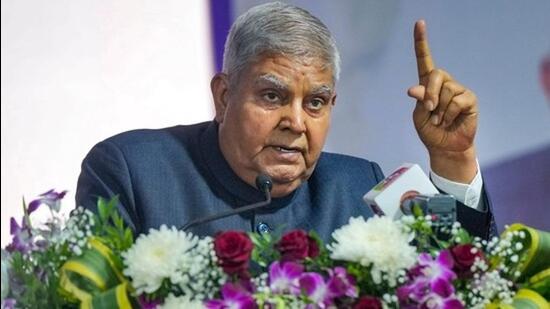
Addressing the inaugural session of the 99th annual meet and national conference of vice chancellors, organised by the Association of Indian Universities (AIU) at Amity University, Noida, Dhankar recalled his experiences when he was West Bengal governor from July 2019 to July 2022 and associated with the development of NEP 2020, which “has really changed the landscape of our education.” He said that the policy was shaped by the inputs of thousands across the nation.
“The policy resonates with our civilizational spirit, essence, and ethos. It is a bold reaffirmation of India’s timeless belief that education is the awakening of the self, not just for education of skills. I have firmly believed that education is a great equaliser. Education brings about equality as no other mechanism does. Education decimates inequities. As a matter of fact, education gives life to democracy,” he said.
NEP 2020 was launched by the union government on July 29, 2020 with an aim to transform the country’s education system — aligning it with needs of the future while keeping it “rooted in Indianness”. The NEP 2020, which replaced an education policy that had been in place since 1986, recommended a major overhaul in India’s education system at all levels from school to higher education.
Dhankar appealed to vice-chancellors of universities to ensure that campuses have space for disagreement, debate, dialogue and discussion.
{{/usCountry}}Dhankar appealed to vice-chancellors of universities to ensure that campuses have space for disagreement, debate, dialogue and discussion.
{{/usCountry}}“Our universities are not meant to just hand out degrees. The degrees must carry great weightage. Universities must be sanctuaries of ideas and ideation, crucibles of innovation. These places have to catalyse big change. That responsibility lies on the vice-chancellors in particular and academia in general. I appeal to you, there must be space for disagreement, debate, dialogue and discussion. That is how the mind cells are activated…,” he said.
The Vice President also paid his tribute to Bharatiya Janata Party (BJP) ideologue Dr Syama Prasad Mookerjee on his ‘Balidan Diwas’, calling it a “great day in the history of our nation.” Recalling Mookerjee’s role in Jammu and Kashmir’s integration, Dhankhar said that Jana Sangha founder in 1952 gave the slogan “Ek Vidhan, Ek Nishan aur Ek Pradhan hoga desh mein, do nahin honge.”
“We suffered from Article 370 for too long. It bled us and the state of Jammu and Kashmir. Article 370 and the draconian Article 35A deprived people of their basic human rights and fundamental rights. …Article 370 does not exist now in our Constitution. It was abrogated on August 5, 2019, and the legal challenge to the Supreme Court failed on December 11, 2023. I therefore cannot be at a more befitting place than this to pay tribute to one of the finest sons of our soil. My tributes to him,” he added.