
 E-Paper



‘Never asked how many enemy jets we shot’: Rajnath Singh on Oppn in Lok Sabha
Rajnath Singh said Operation Sindoor had been “paused” as the armed forces had achieved the desired political and military objectives

 Prefer HTon Google


NEW DELHI: Defence minister Rajnath Singh on Monday said claims that Operation Sindoor was stopped under pressure were “wrong and unfounded”, and stressed that India opted for a “different route for peace” through the surgical strike in 2016, Balakot airstrikes in 2019 and Operation Sindoor in 2025.
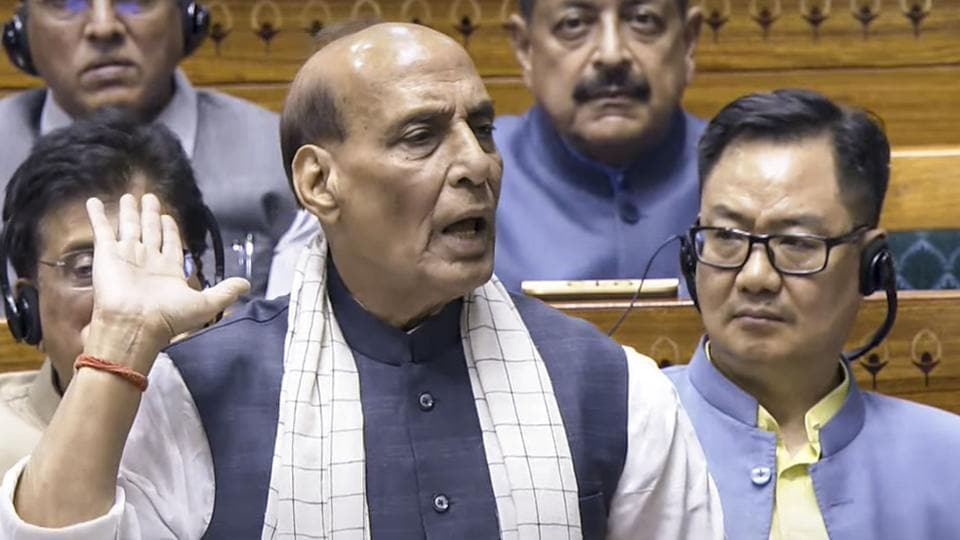
Singh, who opened the discussion on India’s strikes against terror infrastructure across Pakistan, said terror was a “political toolkit for Pakistan” and warned Islamabad that “the operation will resume” if there is any misadventure.
The minister also criticised the Opposition for repeatedly raising questions about the number of aircraft downed during the four-day operation. “We should not be bothered if a pencil is broken or if a pen gets lost. The result is that the targets of our armed forces were fully met,” Singh said to thunderous applause in the Lok Sabha.
“Our focus should not be on smaller issues. Because if you focus on small issues, then the attention on the country’s security and honour of soldiers can get diverted,” he said.
“Sometimes, our opposition leaders ask: how many fighters (were downed)? I think this does not reflect India’s national emotion. The Opposition never asked how many enemy planes have been shot down by our forces,” Singh said.
He continued, “If they want to ask, their question should be, did India demolish terror hideouts? Then the answer is a resounding yes. They should ask if Operation Sindoor is a success? The answer is yes. You should ask, the terrorists who wiped out our sisters’ sindoor, did Operation Sindoor kill their masters? The answer is yes. Did our soldiers suffer? The answer is no.”
India launched Operation Sindoor in the early hours of May 7 and struck terror and military installations in Pakistan and Pakistan-occupied Kashmir (PoK) following the Pahalgam terror attack. Between the launch of the operation in the early hours of May 7 and the ceasefire on May 10 evening, Indian forces bombed nine terror camps in Pakistan and PoK, killing at least 100 terrorists, and the Indian Air Force struck targets at 13 Pakistani airbases and military installations.
Singh, who detailed the sequence of events starting from the Pahalgam terror attack to the ceasefire, called the Pahalgam attack “the ugliest and despicable act of inhumanity” which was “a test of India’s tolerance”.
“Before launching Operation Sindoor, our armed forces studied every aspect of the situation. We had many options, but we chose the option in which the terrorists and their hideouts are inflicted with maximum damage and the common people of Pakistan don’t suffer,” Singh told the Lok Sabha.
The minister hailed Operation Sindoor as an unmatched example of coordination between India’s armed forces. “When he IAF attacked, our army took control of the land. Our navy had a strong presence in north Arabian Sea. “The Navy gave a clear message to Pakistan: from the land and the sea, we are not only capable of hitting every important place, but we are also ready to do it.”
Singh said the Indian armed forces hit nine terror targets with precision. Singh said “more than 100 terrorists including their trainers and handlers of terror groups such as LeT and HM” died in the strikes, according to an estimate, though “the toll is much higher”.
“We stopped the war because we had achieved all the political and military objectives. To say the Operation Sindoor was stopped due to some pressure is unfounded and totally wrong,” Singh said, referring to statements by Opposition leaders who alleged that the military action against Pakistan stopped due to US intervention.
“Operation Sindoor’s politico-military objective was to punish Pakistan which waged a proxy war through terror. That’s why full freedom was given to the armed forces. This operation was not to start a new war but to force the adversary to submit to the Indian armed forces. When IAF attacked the airfields, Pakistan accepted defeat and tried to stop further hostilities. They spoke to DGMO. We accepted with the caveat that the operation has been paused. If there is another misadventure from Pakistan, this operation will restart,” Singh said.
Singh, the senior-most minister in Narendra Modi’s cabinet, spoke about the past efforts by Lal Bahadur Shastri, Atal Bihari Vajpayee, Manmohan Singh and Modi for building peace with Pakistan. “But if a country has no shred of democracy, only religious fanaticism and hatred against India, there can’t be any talks with such a country. The language of terror fuels killings, fear and hatred, not discussion,” he said.
Singh said that Pakistan has made terrorism a part of its foreign policy and going by its policy and character, “there should not be any illusion that Pakistan is a nursery of global terror. And they have made it as a part of state policy,” Singh said.
He spoke about how, during Operation Sindoor, the world saw Pakistani terrorists being given state funerals and how the Pakistan army didn’t have the courage to “fight on the border” but attack innocent people, children and pilgrims.
“Pakistan army and ISI use terror as proxy war. But this is a new Bharat led by Modi, which can go to any extent to fight against terror,” Singh said. He also mocked Pakistan’s socio-economic condition and said, “If a tiger (India) kills a frog (Pakistan), it doesn’t go well. Pakistan is nowhere near us in size, capabilities, prosperity,” Singh said, as he justified the fight against terror.
“India wants to end terror in every form…. It uses terror as a political toolkit. This toolkit is in violation of the civilised code of conduct of the world. It is a battle between civilised people and brutes. Pakistan knows its soldiers can’t win against India, so they nurture terror.”


