E-Paper



New pension scheme to benefit central govt staff
The UPS will also give out family or survivor-pension benefits, fixed at 60% of the last-drawn pension of a deceased employee.

 Prefer HTon Google


The Union cabinet led by Prime Minister Narendra Modi on Saturday approved a new pension policy for nearly 2.3 million central government employees, unveiling a framework that will give assured 50% of basic pay as monthly payout, assuaging federal staff unions that had sought guaranteed retirement benefits.
Also Read | Unified Pension Scheme: Key features and benefits for retirees explained
Modi had set up a panel led by cabinet secretary-designate TV Somanathan, the then finance secretary, in April 2023 to rework the current pension system, known as the new pension scheme or NPS. The move followed widespread grievances that also became a political controversy, with some opposition-ruled states switching to the previous fiscally-straining old pension scheme or OPS.
The new system, the Unified Pension Scheme or UPS, will offer 50% of the average basic pay drawn by a federal employee over the 12 months prior to retirement provided he or she completes 25 years of service. The UPS will take effect on April 1, 2025.
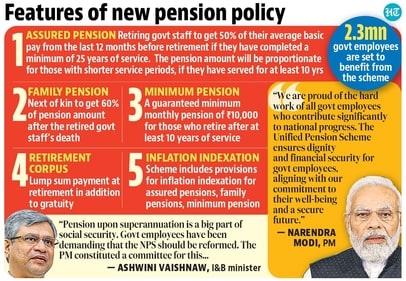
This fulfils a key demand of the joint consultative machinery, a platform that provides a mechanism to federal staff to resolve any dispute with the central government. Under the UPS, if an employee has served less than 25 years but more than 10 years, he or she will get pension on a proportionate basis.
The UPS will also give out family or survivor-pension benefits, fixed at 60% of the last-drawn pension of a deceased employee. Employees who retire with a minimum of 10 years of service will get an assured ₹10,000 as monthly pension.
The UPS will be indexed to the Consumer Price Index for Industrial Workers (CPI-IW), a price-rise gauge compiled by the labour bureau. The CPI-IW will be used to calculate dearness relief, which is a benefit paid to pensioners to account for inflation.
All employees who retired since 2004 will be eligible to opt for the UPS, while the option to continue with the NPS will remain. According to an official, employees joining service before April 2004 will continue under the OPS that offers a fixed pension, which is 50% of their last drawn salary after retirement.
Also Read | How is the new ‘Unified Pension Scheme’ different from NPS?
HT had reported on Oct 18, 2023 that the pension committee had decided to recommend a system which gives an assured monthly payout but ruled out reverting to OPS.
“We are proud of the hard work of all government employees who contribute significantly to national progress. The Unified Pension Scheme ensures dignity and financial security for government employees, aligning with our commitment to their well-being and a secure future,” Modi said in a post on X on Saturday.
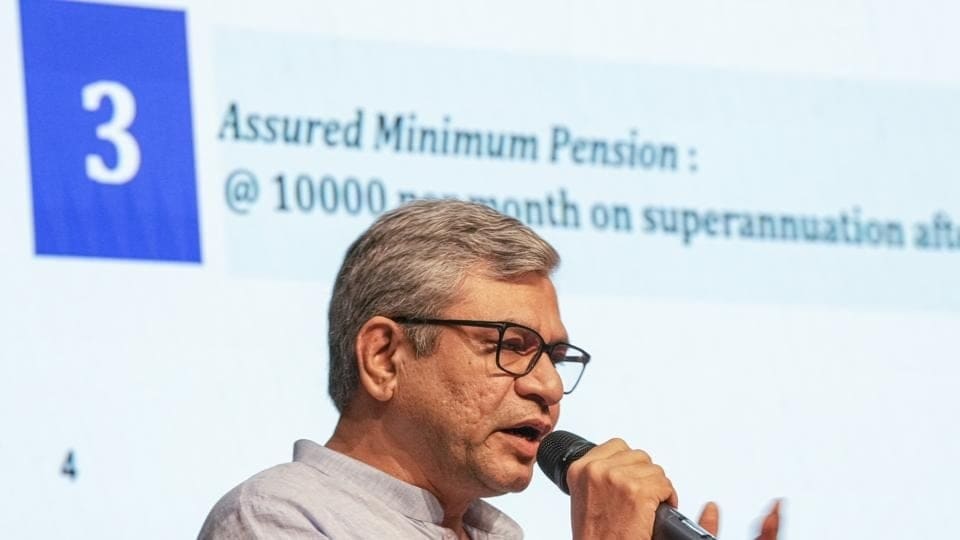
“Pension upon superannuation is a big part of social security. Government employees have been demanding that the NPS should be reformed. The PM constituted a committee for this, which held extensive consultations,” information and broadcasting minister Ashwini Vaishnaw said, briefing reporters.
The NPS is a market-linked, fully funded system and was implemented as a major fiscal reform in 2004, as the previous OPS was a fiscally-straining arrangement because it was unfunded. Funds under NPS are invested in equities, returns from which then determine the amount of eligible pension. In other words, pension under the NPS depended on market returns.
A fully funded pension scheme is one which has yearly on-budget allocations and capable of meeting current and future financial obligations based on the fund’s returns on investment and compulsory contributions.
Somanathan said in the first year of UPS, arrears are expected to cost the government ₹800 crore, while the projected annual pension cost for raising the government’s contribution from 14% to 18.5% is ₹6,250 crore.The government’s contribution would be revised “once in three years”, Somanathan said. The arrears will be paid to all retirees switching to UPS, after adjusting for amounts already drawn by them under NPS. Only those who retired since 2004 will be eligible for arrears.
HT on August 5 reported, quoting a member of the committee, that the old pension scheme was “not viable, financially unacceptable and not feasible”. “It was extremely harmful to the common citizen as it would have consumed a large share of the government’s budget that should be devoted to the welfare of the citizens.”
Under UPS, the government will contribute 18.5% towards an employee’s retirement corpus, while an employee’s share has been kept steady at 10%. “The government has increased its contribution from current 14% and the big difference is that the UPS will give 50% assured returns, leaving nothing to the vagaries of markets,” Somanathan said.
During the stakeholders’ consultation, many states evinced interest to implement UPS, an official said. “Even some states, such as Rajasthan, Chhattisgarh, Jharkhand, Punjab and Himachal Pradesh, who had decided to revert to OPS for their state government employees, may also adopt UPS,” he added.
Presenting the Union Budget on July 23, Union finance minister Nirmala Sitharaman said: “The Committee to review the NPS has made considerable progress in its work. I am happy that the staff side of the National Council of the Joint Consultative Machinery for Central Government Employees have taken a constructive approach. A solution will be evolved which addresses the relevant issues while maintaining fiscal prudence to protect the common citizens.”
Congress leader Rashid Alvi, meanwhile, said that the government should have taken the decision much earlier. “They are doing it now out of pressure. The whole opposition has been saying that government must make some decision regarding pension... retired employees should get pension based on their salary (before retirement), not just 50% (of their salary) but they should get 100%,” he said.