
Days after Shiv Sena snapped ties with the Bharatiya Janata Party (BJP), Union Home Minister and BJP chief Amit Shah on Wednesday said that it will be inappropriate to disclose the deliberations that were held “behind closed doors” between his party and Shiv Sena over government formation in Maharashtra.
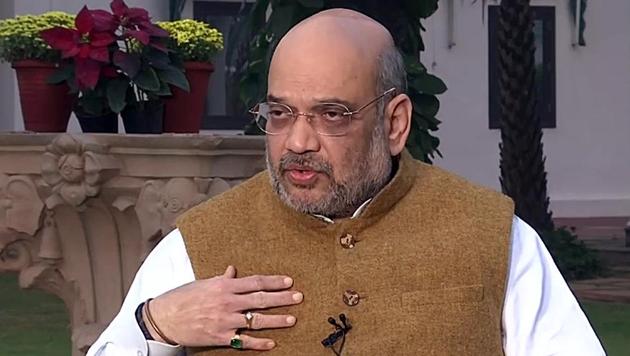
When asked what stopped the BJP from forming the government with its ally Shiv Sena, Shah said, “This is not in the ethics of my party to make public discussions that were held behind the closed doors. There has to be the dignity of public discourse,” he said.
“But I would like to make it clear that if there is any party which has suffered the most with the imposition of President’s Rule in Maharashtra, then it is the BJP. We have lost a caretaker government. The opposition has lost nothing,” Shah, in an interview told Smita Prakash, Editor, ANI.
“If they (Opposition) wanted to gain public sympathy by creating a misconception about president’s rule, then it means they do not trust the intelligence of the public,” he added.
Shah said that BJP wanted to form the government with Shiv Sena in the state, but some conditions laid by the latter were not acceptable to the BJP.
{{/usCountry}}Shah said that BJP wanted to form the government with Shiv Sena in the state, but some conditions laid by the latter were not acceptable to the BJP.
{{/usCountry}}He said BJP had made it clear many times that if BJP-Sena alliance wins a majority, then Devendra Fadnavis will be chief minister of the state again.
“I said it a hundred times in public rallies, Prime Minister said it that if our alliance wins a majority then Devendra Fadanvis will be the chief minister. No one objected then. Now they (Sena) came up with new demands which were not acceptable to us. If there are new conditions, we have reservations on them,” Shah, who is also Union Home Minister, said.
“But I would like to say that the hullabaloo over president’s rule is a useless exercise to gain public sympathy,” he added.
Asked what would happen after president’s rule ends in six months, Shah said he did not want midterm elections in Maharashtra.
“I do not want re-election in Maharashtra. After the completion of the six-month period, the Governor will take legal opinion and take the constitutional step. Those who say that imposing president’s rule was unconstitutional, I would like to tell them that they still have their rights. They just do not have the required numbers. If they have numbers, then they can go and form the government,” the BJP president outlined.
Maharashtra came under the president’s rule on Tuesday. The President signed the notification following the recommendation of the Union Cabinet, which acted on the report from Maharashtra Governor Bhagat Singh Koshyari.
The Governor had recommended the imposition of president’s rule in the wake of the political stalemate over the government formation in the state.
Shiv Sena led by Uddhav Thackeray emerged as the second-largest party in last month’s Maharashtra assembly elections with 56 seats. The two parties, who fought the elections together, were at loggerheads over power-sharing.
The BJP emerged as the single-largest party with 105 seats in the 288-member state assembly.
Shiv Sena insisted that the two parties had a ‘50-50’ power-sharing agreement before the elections. Fadnavis said that Shiv Sena was not promised the chief ministerial post for two-and-a-half years when the alliance was sealed before the 2019 Lok Sabha polls.
ABOUT THE AUTHOR
Follow the latest breaking news, major developments and agenda-setting stories from India and around the world with the newsdesk at Hindustan Times. Operating round the clock, the desk brings together experienced editors, reporters and correspondents to deliver fast, accurate and contextual reporting across subjects that influence public policy, governance, business, society and international affairs. The HT News Desk covers politics, elections, government policies, the economy, business and markets, science and technology, the environment, law and order, infrastructure, education, climate issues and geopolitics, while closely tracking developments across states, institutions and global capitals. The team also leads coverage of major breaking news events, policy announcements, court proceedings, natural disasters, public emergencies and significant international developments. Reports published by the newsdesk are based on information gathered from reporters on the ground, official statements, government agencies, court records, regulatory filings, recognised institutions and other authoritative sources. Stories undergo editorial scrutiny and verification processes to ensure accuracy, fairness and relevance, and are updated as events evolve and additional information becomes available. Whether covering a key political decision in New Delhi, an economic policy shift affecting millions, a landmark court ruling or a major global event, the HT News Desk aims to provide readers with reliable, fact-based journalism that delivers not only the latest developments but also the context and analysis needed to understand their wider implications.