
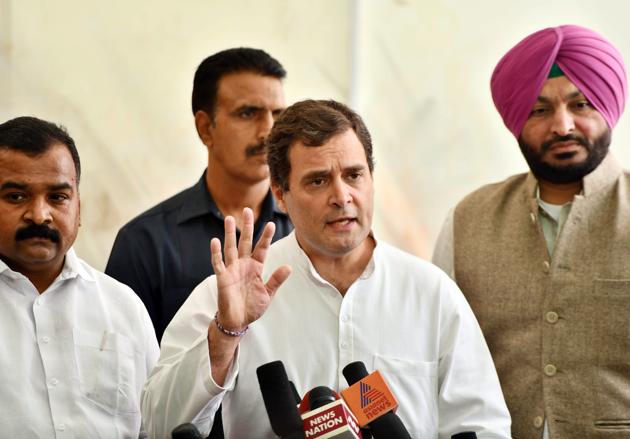
Congress leader Rahul Gandhi criticised the government on Tuesday for what he said was a delay on its part in the purchase of testing kits for Covid-19 and said the country is “now critically short of them”.
The comments by the former Congress president came after the Indian Council of Medical Research (ICMR) said on Monday that the rapid testing kits, which were supposed to be in the country on April 5 and then April 10, will now reach by April 15.
These kits are being seen as the next phase of India’s strategy to combat the coronavirus disease with widespread and rapid testing not just in hot spots and containment zones but also areas relatively free of the virus.
Rapid Test Kits, or RTKs, are blood tests that search for antibodies in the sample of those tested. A positive test means the person is or has been infected by the virus.
“With just 149 tests per million Indians, we are now in the company of Laos (157), Niger (182) & Honduras (162). Mass testing is the key to fighting the virus. At present we are nowhere in the game,” Rahul Gandhi tweeted.
The Congress leader’s tweet also came on a day India recorded 10,363 coronavirus cases and 339 deaths. Prime Minister Narendra Modi also announced the extension of the 21-day lockdown from March 25 till May 3 to arrest the spread of the infection.
{{/usCountry}}The Congress leader’s tweet also came on a day India recorded 10,363 coronavirus cases and 339 deaths. Prime Minister Narendra Modi also announced the extension of the 21-day lockdown from March 25 till May 3 to arrest the spread of the infection.
{{/usCountry}}Also read: ‘Arrest virus, revive economy’: PM Modi has a double-barrel lockdown exit plan
Countries around the world are looking to use these tests to determine who has immunity to the Sars-CoV-2 virus that causes Covid-19 apart from being a fast way to identify the extent of infections in clusters.
RTKs give out results in 30 minutes unlike the RT-PCR tests currently in use, which take up to five hours to throw up a result. However, ICMR’s protocol requires a confirmatory RT-PCR test to back up a negative RTK result.
ICMR raised a tender on April 11 for 4.5 million more rapid testing kits to be delivered in batches apart from the order for 500,000 kits that has already been placed. The plan is to have the first batch in by May 1 and the final batch latest by May 31.
Also read: Congress backs lockdown extension but asks PM Modi to spell out strategy to fight
India had ordered 500,000 kits from Chinese suppliers on March 30.
In addition, several Indian states have also placed orders for RTKs.
ABOUT THE AUTHOR
Follow the latest breaking news, major developments and agenda-setting stories from India and around the world with the newsdesk at Hindustan Times. Operating round the clock, the desk brings together experienced editors, reporters and correspondents to deliver fast, accurate and contextual reporting across subjects that influence public policy, governance, business, society and international affairs. The HT News Desk covers politics, elections, government policies, the economy, business and markets, science and technology, the environment, law and order, infrastructure, education, climate issues and geopolitics, while closely tracking developments across states, institutions and global capitals. The team also leads coverage of major breaking news events, policy announcements, court proceedings, natural disasters, public emergencies and significant international developments. Reports published by the newsdesk are based on information gathered from reporters on the ground, official statements, government agencies, court records, regulatory filings, recognised institutions and other authoritative sources. Stories undergo editorial scrutiny and verification processes to ensure accuracy, fairness and relevance, and are updated as events evolve and additional information becomes available. Whether covering a key political decision in New Delhi, an economic policy shift affecting millions, a landmark court ruling or a major global event, the HT News Desk aims to provide readers with reliable, fact-based journalism that delivers not only the latest developments but also the context and analysis needed to understand their wider implications.